Conference Proceedings Available!
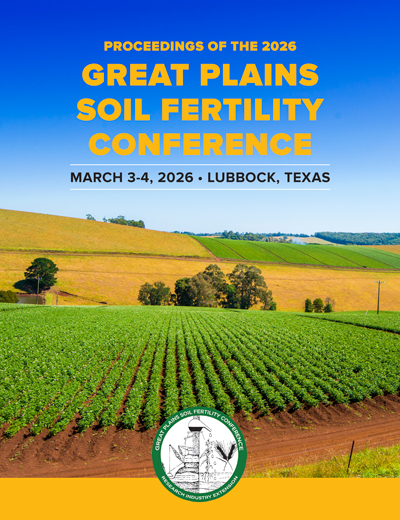
 
The 2024 Great Plains Soil Fertility Conference Proceedings Book is now available! Click the link below to view the full document!
 
GPSFC Proceedings - 2024.pdf

Proceedings

Find matching any: Reset
Lawley, J.R
Detter, N
Brandt, A.D
Bainard, L
Seymour, D
Schmer, M
Sharry, R
Add filter to result:
Authors
Schmer, M
Jin, V
Wienhold, B
Varvel, G
Delgado, J.A
Floyd, B
D'Adamo, R
Villacis, A
Brandt, A.D
Halvorson, A
Stewart, C.E
Alwang, J
Del Grosso, S
Manter, D.K
Hopkins, B.G
Cardon, G.E
Lawley, J.R
Lovewell, H
Finch, B
Sharry , R
Smith, M
Souza, J
Arnall, B
Cade-Menun, B
Bainard, L
Arnall, B
Singh, R
Sharry, R
Holman, J
Detter, N
Obour, A
Tamea, P
Holman, J
Detter, N
Obour, A
Haag, L
Roozeboom, K
Sharry, R
Smith, M
Arnall, B
Topics
Environment and Soil
Nutrient Management and Analysis
General Posters
General
Student
Type
Oral
Poster
Year
2020
2022
2024
Home » Authors » Results

Authors

Filter results9 paper(s) found.

1. Long-term Crop Rotation Diversity Effects on Soil C and N

The objective of this study was to evaluate the effects of nitrogen (N) fertilizer level and crop rotation diversity on soil organic carbon (SOC) and N stocks from a 34-yr study located in eastern Nebraska. Seven crop rotations (three continuous cropping systems; two 2-yr crop rotations, and two 4-yr crop rotations) and three N levels were compared. Soil samples were taken to a depth of 60-inches. Differences in SOC stocks were largely confined to the 0 to 3-inch depth with greater SOC (P =... M. Schmer, V. Jin, B. Wienhold, G. Varvel

2. Effects of Climate Change and Narrow Rows with Higher Plant Densities on Yields of Irrigated Corn

Climate change is significantly impacting agricultural systems worldwide, and although there are reports of these impacts contributing to higher yields in some regions, the general consensus is that there will be negative impacts on yields and soil quality across large regions.  Management practices that can contribute to higher yields and adaptation to a changing climate will be important during the 21st century. This presentation will cover results from two manuscripts that are currently... J.A. Delgado, B. Floyd, R. D'adamo, A. Villacis, A.D. Brandt, A. Halvorson, C.E. Stewart, J. Alwang, S. Del grosso, D.K. Manter

3. Soil Analysis Methods Accuracy and Precision Comparison: Historical North American Proficiency Testing (NAPT) Program Results

The SSSA-NAPT Program provides open access to soil, water, and plant laboratory data. This data is collected quarterly from about 150 participating laboratories. For soil data, five samples are sent to participant laboratories for them to submit data for any or all of the 99 accepted methods. Our objective was to evaluate data precision from 43 soil samples (2019-2021). A measure of precision was made by dividing the Median Absolute Deviation (MAD) by the Median for each of the 43 samples... B.G. Hopkins, G.E. Cardon, J.R. Lawley

4. Effects of Phosphorus and Potassium Application Timing on a Wheat Double Crop Soybean System

The wheat-double crop soybean system is a popular choice for Oklahoma producers, as it allows for two crops in one year, and therefore, more revenue in less time. With favorable conditions and proper management, double crop soybeans are yielding as well as full season soybeans. Weather pattern shifts over the last few years have raised the question for growers if they should invest more into the summer double crop, as there is growing potential for profit. While attempting... H. Lovewell, B. Finch, R. Sharry , M. Smith, J. Souza, B. Arnall

5. Soil Phosphorus Forms and Cycling Are Altered by Acidification from Nitrogen Fertilization in Long-term Wheat Plots in Swift Current, Saskatchewan

Soil acidification from high rates of nitrogen (N) fertilization is recognized as a significant problem in many countries, altering many aspects of soil health. However, new research suggests that this is also a problem for soils receiving lower rates of ammonium-N (NH4-N) over long time periods, including on the North American Great Plains. Soil phosphorus (P) cycling is particularly vulnerable to acidification, because P is optimally soluble in soils within a limited pH range. This... B. Cade-menun, L. Bainard

6. Effect of Manure Applications Compared to Commercial Fertilizer for Total Nitrogen in Dryland Winter Wheat (Triticum Aestivum L.)

The Magruder plots are one of the staples in research agriculture not only in Oklahoma but across the country. The historic data gathered from the Magruder Plots allows for the analysis of long term data sets in excess of 124 years of data.  The Magruder treatment structure allows for the comparison of the added benefits of manure applications as compared to inorganic sources of fertilizers. Manure applications were made once every four years as a total nitrogen source compared to annual... B. Arnall, R. Singh, R. Sharry

7. Effect of Seeding Rate on Annual Warm Season Forage Yield and Plant Structure

Due to the decline of the Ogallala Aquifer and reduced irrigation capacity, there is growing interest in more water-efficient cropping systems in the semi-arid central Great Plains. To support the region’s livestock industry, there is increased interest in forages because they use water more efficiently than grain crops. However, there is insufficient information on summer annual forage seeding rates in the range of environments encountered in the region. The objective of this study was... J. Holman, N. Detter, A. Obour, P. Tamea

8. Summer Annual Legumes: Yield Potential and Water Use

Due to the decline of the Ogalla Aquifer and reduced irrigation capacity, there is a growing interest in more water-efficient cropping systems in the semi-arid central Great Plains. One of the most water-intense crops grown on the semi-arid central Great Plains is alfalfa (Medicago sativa L.). Alfalfa is grown for its nutritive value and protein, which is highly desired by cow/calf, feed yards, and dairies of the central and southern Great Plains. The purpose of this study was to evaluate... J. Holman, N. Detter, A. Obour, L. Haag, K. Roozeboom

9. Nitrogen Management of Cotton Following Corn in the High Plains

Nitrogen (N) management in cotton (Gossypium hirsutum) is challenging given physiological dynamics in an indeterminate crop. Cotton performance may be harmed due not only to under fertilization of N, but also excessive fertilization. This is especially pertinent when managing cotton for earliness. Often these challenges occur in the form of delaying the onset of reproductive structures due to the crops indeterminate nature, leading to problems associated with "finishing"... R. Sharry, M. Smith, B. Arnall