Conference Proceedings Available!

 
The 2026 Great Plains Soil Fertility Conference Proceedings Book is now available! Click the link below to view the full document!
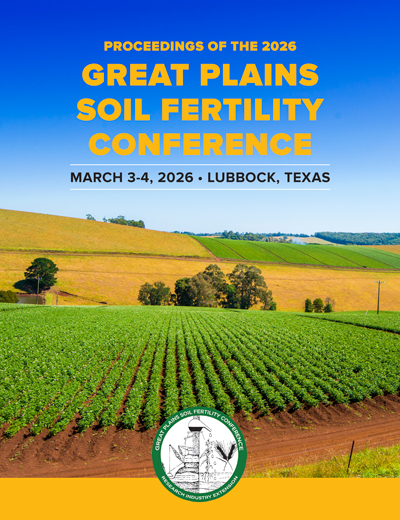
 
2026_GPSFC_Proceedings.pdf

Proceedings

Find matching any: Reset
Norton, U
Stone, L
Cotrufo, F
Robinson, D
Smith, M
Hernandez-Ramirez, G
Matschek, R
Sharry, R.L
Add filter to result:
Authors
Oleszak, H
Cotrufo, F
Leichty, S
Stewart, C
Helseth, C
Norton, U
Moore, E
Norton, U
Daly, E
Kim , K
Hernandez-Ramirez, G
Klimchuk, K
Sharry, R.L
Arnall, B
Lovewell, H
Finch, B
Sharry , R
Smith, M
Souza, J
Arnall, B
Smith, M
Arnall, B
Derrick, J
Arnall, B
Smith, M
Bigatao Souza, J
Sharry, R
Smith, M
Arnall, B
Topics
General Posters
Conservation Impacts on Soil Health
Student
Type
Poster
Oral
Year
2020
2022
2024
Home » Authors » Results

Authors

Filter results9 paper(s) found.

1. Effects of Residue Placement on Co2 Loss in an Irrigated, No-till Corn System

It is well known that residue management practices that leave crop residue on the surface, such as no-till agriculture, promote soil fertility. However, the effects of such practices on carbon sequestration can be highly variable. To better understand how residue management impacts the loss of carbon through mineralization, we investigated the effects of residue location and addition on CO2 produced from residue decomposition under no-till irrigated continuous corn in Northern Colorado. Over... H. Oleszak, F. Cotrufo, S. Leichty, C. Stewart

2. Long-Term Effects of a Large Composted Cattle Manure Application Followed by Cover Crops to Organic Dryland Winter Wheat Cropping Systems

Organic agriculture in semi-arid environments can face several challenges in order to produce a successful crop.  These include nitrogen and phosphorus deficiencies, moisture limitations, and high weed competition.  Organic winter wheat (Triticum aestivum, L.)-fallow systems can be amended with composted cattle manure and with green manure from cover crops grown in the fallow phase to help increase wheat yields and quality.  Cattle manure can improve soil health with the... C. Helseth, U. Norton

3. Cover Crops in Certified Organic, Specialty Crop Food Production

There is a growing interest in certified organic, specialty crop food production. With a larger population demanding organic products and organic products offering a higher premium for the producer, farmers are exploring the transition to organic farming. Organic producers in southeastern Wyoming face multiple challenges in environments with high elevation, low precipitation, and have a short growing season. These challenges include management of persistent weeds, maintaining biodiversity, and... E. Moore, U. Norton

4. Soil Physical Quality Effects of Novel Perennial Grain Cropping at Two Contrasting Sites in Alberta, Canada

Novel perennial grain crops have been proposed as a solution to several environmental issues facing modern agriculture, namely the loss of soil quality often associated with annual monocrops. Abundant literature has stressed the importance of good soil quality for maintaining and improving ecosystem services provided by agricultural systems including, but not limited to, soil carbon sequestration, disease suppression and water filtration. Conversion of annual croplands to perennial systems has... E. Daly, K. Kim , G. Hernandez-ramirez, K. Klimchuk

5. In-season Nitrogen Application Method Influence on Grain Sorghum Performance

Grain sorghum production in the United States is concentrated in the great plains. This region is prone too harsh environments that may provide opportunities for extensive N losses when relying on pre-plant N application alone. This problem may be alleviated through moving N application later in the growing season to optimize N availability when plant N uptake is most required to prevent yield loss. However, fertilizer application equipment availability may be limited for many producers in the... R.L. Sharry, B. Arnall

6. Effects of Phosphorus and Potassium Application Timing on a Wheat Double Crop Soybean System

The wheat-double crop soybean system is a popular choice for Oklahoma producers, as it allows for two crops in one year, and therefore, more revenue in less time. With favorable conditions and proper management, double crop soybeans are yielding as well as full season soybeans. Weather pattern shifts over the last few years have raised the question for growers if they should invest more into the summer double crop, as there is growing potential for profit. While attempting... H. Lovewell, B. Finch, R. Sharry , M. Smith, J. Souza, B. Arnall

7. Effects of Potassium and Boron on Cotton Lint Yield

The importance of potassium (K) is numerously documented as it’s essential for photosynthesis, stomatal regulation, enzyme activation and chlorophyll development. While a majority of cotton production occurs in the southwest portion of Oklahoma, producers from south to northwest are implementing rotations of cotton and wheat. In the western portion of the state soil pH becomes increasingly alkaline [whereas areas in wheat production are predominantly acidic]. Although K becomes more available... M. Smith, B. Arnall

8. Evaluation of N Source in No-till Winter Wheat

Nitrogen (N) source efficacy is dependent upon product used, application timing, and the condition of the environment in which it is placed. This study serves to look at how different N sources can be affected across different regions of Oklahoma, specifically in a heavy residue, no-till environment. N sources that were included in the study were Urea, Urea-Ammonium Nitrate (UAN), UAN + Anvol, and SuperU. The N sources were evaluated across nine site-years (SY) where each product had four... J. Derrick, B. Arnall, M. Smith, J. bigatao souza

9. Nitrogen Management of Cotton Following Corn in the High Plains

Nitrogen (N) management in cotton (Gossypium hirsutum) is challenging given physiological dynamics in an indeterminate crop. Cotton performance may be harmed due not only to under fertilization of N, but also excessive fertilization. This is especially pertinent when managing cotton for earliness. Often these challenges occur in the form of delaying the onset of reproductive structures due to the crops indeterminate nature, leading to problems associated with "finishing"... R. Sharry, M. Smith, B. Arnall