Conference Proceedings Available!
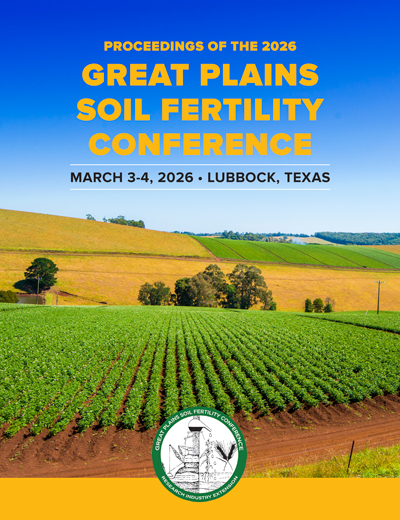
 
The 2026 Great Plains Soil Fertility Conference Proceedings Book is now available! Click the link below to view the full document!
 
2026_GPSFC_Proceedings.pdf

Proceedings

Find matching any: Reset
Delgado, J
Lewis, K
Bauder, S
Ashley, R
Ransom, C.R
Akin, S.G
Add filter to result:
Authors
Stewart, C
Manter, D
Delgado, J
Del Grosso, S
Calderon, F
Heckman, K
Snell, K
DeLaune, P
Lewis, K
Mubvumba, P
Pabuayon, I.B
Ritchie, G
Lewis, K
Bumguardner, A
Wheeler, T
Lewis, K
Burke, J
Kelley, D
Lewis, K
McDonald, M
DeLaune, P
Gentry, T
Lewis, K
Bumguardner, A
Lewis, K
Ritchie, G
Bronson, K
Maeda, M
Sexton, P
Kumar, S
Osborne, S
Brockmueller, B
Bly, A
Rops, B
Bawa, A
Bauder, S
McMaine, J
Del Grosso, S
Derner, J
Delgado, J
Boogades, N
Lewis, K
Gentry, T
DeLaune, P
Ellman-Stortz, L.M
Akin, S.G
Arnall, B
Kitchen, N.R
Svedin, J.D
Anderson, S.H
Veum, K.S
Ransom, C.R
Burke, J
Lewis, K
DeLaune, P
Valencia, H
Burke, J
Roberts, T
Lewis, K
Burke, J
Lewis, K
Keeling, W
Keeling, W
Lewis, K
Valencia, H
Roberts, T
Burke, J
Ritchie, G
Burke, J
Lewis, K
Foster, J
Boogades, N
Lewis, K
Cobos, C
Burke, J
DeLaune, P
Valencia, H
Lewis, K
Foster, J
Lewis, K
Babcock, R
Burke, J
Cobos, C
Guo, W
Karn, R
Lewis, K
Siebecker, M
Coyle, K
Pham, T
Saldana Haworth, I
Schmidt, E
Sharma, A
Lewis, K
Kafle, A
Lewis, K
Burke, J
Nakabuye, H
Jonhson, M
Wright, A
Burke, J
Lewis, K
Keeling, W
Keeling, W
Lewis, K
Alford, J
Burke, J
Lewis, K
Topics
Cover Crops and Nutrients
General Posters
Conservation Impacts on Soil Health
Environment and Soil
Student
General
General
Type
Oral
Poster
Year
2020
2022
2024
2026
Home » Authors » Results

Authors

Filter results26 paper(s) found.

1. Nitrogen Fertilization and Long-term No-tillage Impacts on Soil Properties and Deep Soil C Storage Under Irrigation

The net soil greenhouse gas mitigation potential of conservation agricultural management practices is strongly influenced by the direction and magnitude of soil organic C (SOC) change in deep soil layers (>6”). Deep SOC is typically old, highly processed, and consists of microbial products and root exudates associated with clay and other minerals. However, it can be susceptible to decomposition and priming from the addition of new, labile organic C. We examined long-term soil C dynamics... C. Stewart, D. Manter, J. Delgado, S. Del grosso, F. Calderon, K. Heckman, K. Snell

2. Nitrogen Availability Following Cover Crops in TX Cropping Systems

Cover crops have been heavily promoted to improve soil health and function in US agricultural productions systems. Within semi-arid environments, interest in cover crops continues to grow although several concerns hinder adoption. As soil water use by cover crops is often a chief concern, nutrient availability to subsequent crops is also a concern. The objective of this study was to measure soil chemical and biological properties following various cover crops in a continuous cotton system under... P. Delaune, K. Lewis, P. Mubvumba

3. Nutrient Partitioning Changes in the Past 30 Years of Cotton Production

Modern cotton (Gossypium hirsutum L.) cultivars are more compact and efficient due to optimization of genetics and changed management practices in the past 30 years. The most recent work evaluating nutrient uptake by cotton was done in early 1990s, hence a need to re-evaluate the nutrient accumulation and requirements in modern high productivity cultivars. The objective of this study was to compare the resource allocation of modern cotton cultivars (PM HS26, FM 958, and DP 1646)... I.B. Pabuayon, G. Ritchie, K. Lewis

4. Optimizing Irrigation and Fertilizer Management in Cotton to Increase Nitrogen Use Efficiency

Nitrogen (N) fertilizer is an important nutrient in cotton production, and if the optimal amount is not applied yield penalty may occur (Hutmacher et al. 2004). A more efficient application of N fertilizer based on plant N requirements, soil texture, and N availability can increase cotton yield and N-use efficiency (NUE). The main objective of this research was to determine the relationship between cotton lint yield and normalized difference vegetation index (NDVI) across multiple irrigation levels,... A. Bumguardner, T. Wheeler, K. Lewis

5. Nitrogen Management in Conservation Systems to Increase Use Efficiency and Cotton Production

Conservation management practices like no-tillage and cover crops have the potential to reduce wind erosion and stimulate ecosystem service, but lingering doubts regarding nutrient immobilization and water usage may limit their adoption on the Texas High Plains. A study was initiated at the Agricultural Complex for Advanced Research and Extension Systems (AG-CARES) in Lamesa, TX to examine the impact of supplemental nitrogen (N) fertilization on cotton yields and nitrogen use efficiency (NUE)... J. Burke, D. Kelley, K. Lewis

6. Conservation Management and Nitrogen Fertilization to Enhance Soil Chemical and Biological Properties  

Cover crops and no-tillage are increasing in use across Texas. On the Southern High Plains (SHP) these practices are important mitigators of wind erosion and are suggested to increase soil health and other positive soil attributes. This study aimed to monitor and evaluate the soil chemical and biological changes that occur shortly after implementing conservation practices  and nitrogen management strategies on the SHP. It was determined that in the short term some soil chemical and biological... M. Mcdonald, P. Delaune, T. Gentry, K. Lewis

7. Relationship Between Plant Nitrogen and NDVI of Cotton on the Texas High Plains

Nitrogen (N) is one of the most limiting factors in Texas High Plains cotton production (Bronson et al., 2001). Nitrogen build-up in cotton is near maximum for the season at first open boll, when leaf senescence begins (Li et al., 2001). Lint yield response to N is difficult to predict due to N response relying on water management and initial soil nitrate (NO3--N) (Morrow and Krieg, 1990). Normalized difference vegetative index (NDVI) is a tool that has been used to manage... A. Bumguardner, K. Lewis, G. Ritchie, K. Bronson, M. Maeda

8. Snapshot of Crop Nutrient Balance with Use of a Rye Cover Crop in a Corn-soybean Rotation Under Tile Drainage in Eastern South Dakota

The purpose of this study was to evaluate the effect of using a winter rye cover crop within a corn/soybean rotation (rye seeded every fall and burned down each spring) on drainage water quality, crop nutrient status, and grain yield.  Use of a winter rye cover crop to take up available N from the soil profile is a management tool that may help to lessen nutrient movement out of the soil profile while at the same time contributing to improved soil health.  Winter rye is very winter hardy... P. Sexton, S. Kumar, S. Osborne, B. Brockmueller, A. Bly, B. Rops, A. Bawa, S. Bauder, J. Mcmaine

9. Legacy Impacts of Cattle Grazing on Soil N2O and CH4 Fluxes in Shortgrass Steppe

Grazing cattle directly emit CH4 from enteric fermentation and contribute to soil N gas emissions related to nitrogen and organic matter additions from urine and manure deposits. Grazed soils can be sources or sinks of CH4, depending on moisture levels and localized manure patches. N2O emissions are related to availability of water as well as mineral N and labile C substrates in soil. Previously, we observed higher N2O and NH3 losses from fresh patches of urine and manure compared to... S. Del grosso, J. Derner, J. Delgado

10. Soil Health Comparison in Organic and Conventional Cotton-Peanut Rotations in the Texas Plains Region

 Organic farming has been increasingly adopted in the Texas High Plains (THP), but restrictions on synthetic fertilizer use may be problematic if a system cannot mineralize sufficient nutrients from organic matter breakdown to meet crop needs. Cover crops are a tool utilized by both organic and conventional producers for nutrient management, weed control and soil conservation. A one-year study was conducted in organic peanuts in Lubbock and Vernon, TX, to assess the ability of cover crops... N. Boogades, K. Lewis, T. Gentry, P. Delaune, L.M. Ellman-stortz

11. Analysis of 10 Years of N Rate and Timing Work in Oklahoma Winter Wheat

This study was conducted to determine optimum top-dress nitrogen fertilizer rate by location and environment so it may be reproduced in following years. Winter wheat was planted in different locations each year starting in 2009. Each location had a treatment structure consisting of Preplant nitrogen rates ranging from 28.02kg/ac to 224.17kg/ac and top-dress nitrogen rates ranging from 28.02kg/ac to 140.11kg/ac. When top-dressing occurred there was two plots that had sensor based rates that used... S.G. Akin, B. Arnall

12. Can Soil Health Metrics Improve Standard Soil Fertility Recommendations?

It is commonly speculated that integrating soil health (SH) testing with soil fertility (SF) testing would improve fertilizer recommendation decisions. However, quantified impacts of SH properties, specifically soil biological properties, on fertilizer demand have not been well established. The objective of this research was to explore corn (Zea mays L.) yield response to phosphorus (P) and potassium (K) fertilization as influenced by established SF analysis and common SH metrics.... N.R. Kitchen, J.D. Svedin, S.H. Anderson, K.S. Veum, C.R. Ransom

13. Soil Health and Cotton Production in the Semi-arid Texas High Plains

Soil health has become a ubiquitous term in agriculture, but little is known about the impact of cropping system management on soil health metrics in semi-arid regions because of the majority of research has been conducted in humid or sub-humid regions of the United States. As a leading commodity of the semi-arid Southwest, cotton is an ideal candidate for soil health review. The purpose of this study was to assess a proposed set of soil health metrics in cotton production on the semi-arid Texas... J. Burke, K. Lewis, P. Delaune

14. Subsurface Drip Fertigation Impacts on Nutrient Uptake and Partitioning in Cotton

Subsurface drip irrigation (SDI) is becoming a popular option for maximizing the water use efficiency of cotton (Gossypium hirsutum), especially in semi-arid environments of the Midsouth and Western United States. In the Texas High Plains where underground water resources from the Ogallala Aquifer are rapidly declining, there is increased adoption of water conservation technologies like center pivot and drip irrigation. In addition to increased water efficiency, drip irrigation allows... H.L. Valencia, J. Burke, T. Bennett, K. Lewis

15. Nitrogen Management in Semi-arid Conservation Cotton Production Systems

The Southern High Plains (SHP) region of Texas is one of the largest cotton-producing regions in the United States. Cotton production is hindered by climatic conditions and wind erosion, but attempts have been made to adopt conservation management practices like cover crops and crop rotations to limit these effects. Conservation management practices can reduce a soil’s susceptibility to wind erosion, but their adoption has been limited on the SHP due to producers’ concerns regarding... J. Burke, K. Lewis, W. Keeling, W. Keeling

16. Developing Nitrogen and Phosphorus Fertigation Strategies in Cotton

Subsurface drip irrigation (SDI) is becoming a popular option for maximizing the water use efficiency of cotton (Gossypium hirsutum), especially in semi-arid environments of the Midsouth and Western United States. In the Texas High Plains where underground water resources from the Ogallala Aquifer are rapidly declining, there is increased adoption of water conservation technologies like center pivot and drip irrigation. In addition to increased water efficiency, drip irrigation allows... K. Lewis, H. Valencia, T. Roberts, J. Burke, G. Ritchie

17. Relationship Between Soil Health and Nutrient Availability in Semi-arid Cotton Production

The use of conservation management practices, like cover crops and no-tillage, is common in semi-arid cropping systems to reduce wind erosion. However, the use of these practices can also reduce cotton lint yield. The purpose of this study was to determine the impact of nitrogen (N) management in conservation cropping systems to increase cotton lint yield. Two experiments were conducted at the Agricultural Complex for Advanced Research and Extension Systems in Lamesa, TX, USA. The first experiment... J. Burke, K. Lewis, J. Foster

18. Carbon and Nutrient Dynamics in Regenerative Cotton Production Systems of the Texas Southern High Plains

Carbon (C) sequestration in soil provides environmental and agronomic benefits. However, building soil C in semi-arid cotton systems is difficult due to low rainfall, low biomass production and high temperatures. Regenerative systems, which utilize practices such as cover cropping and crop rotation, can increase the amount of C input in cotton (Gossypium hirsutum) production systems, but they may increase C losses via carbon dioxide (CO2) due to increased respiration from soil... N. Boogades, K. Lewis, C. Cobos, J. Burke, P. Delaune

19. Double Cropping Wheat System Effects on Soil Extracellular Enzyme Activity Related to Nitrogen and Phosphorous Cycling Across Texas

Conventional management of agricultural systems can threaten soil health by contributing to soil erosion, soil carbon loss, and inefficient water use in crop production. Cover crops and conservation tillage have been reported to improve soil health, but the additional planting and maintenance comes at an additional cost. Double-cropping systems have the potential to mitigate that cost by providing producers a secondary crop with an additional source of income while providing soil health benefits.... H. Valencia, K. Lewis, J. Foster

20. Sustainable and Resilient Cropping Systems to Mitigate Wind Erosion for the Enhancement of Human Health

In the Texas High Plains, regenerative cropping practices in a predominantly conventional farming area can be used to prevent further depletion of topsoil by wind erosion. This loss of topsoil can cause a decrease in agricultural productivity and form dust storms that can be detrimental to human health causing a rise in hospitalizations of chronic lung damage, cardiovascular disorders, and diseases contracted by inhalation. Using regenerative farming practices, both the number and size of dust... K. Lewis, R. Babcock, J. Burke, C. Cobos

21. Advancing Precision Nitrogen Management in Agriculture: a Multifaceted Approach

Advancing precision nitrogen management in agriculture involves achieving a balance between maximizing crop yield and minimizing environmental impact. Traditional nitrogen management approaches often lead to inefficiencies, contributing to environmental issues such as nitrous oxide emissions and nitrogen runoff. Significant challenges persist in quantifying factors influencing nitrogen dynamics in the soil-plant-atmosphere system, including landscape positions, soil properties, weather patterns,... W. Guo, R. Karn, K. Lewis

22. Shining Light on Novel Pathways for Potassium Fixation in Soil

Cotton has a high demand for potassium, and potassium significantly affects both cotton yield and fiber quality. Thus, bioavailability of potassium from the soil is paramount. Bioavailability and leaching of potassium to crops and from soils has been studied since the 1940s. However, problems that confronted agronomists in the 1980s continue to impact growers and crop production, including unpredictable potassium bioavailability and inconsistent plant response to fertilizer application under a... M. Siebecker, K. Coyle, T. Pham, I. Saldana haworth, E. Schmidt, A. Sharma, K. Lewis

23. Assessment of Microalgae Amendments on Soil Nutrient Dynamics and Cotton Productivity Under Limited Irrigation in Texas High Plains

Texas High Plains (THP) is a major cotton producing region of Texas. However, declining soil fertility and increasing risk of crop yield penalties associated with extreme weather patterns and low organic input have raised concern in sustainability of farmlands in this region. Micro-algae amendment is relatively new and emerging farm practice in crop production which is getting attention due to its ability to stimulate soil health and enhance crop productivity. There are no prior records on microalgae... A. Kafle, K. Lewis, J. Burke, H. Nakabuye, M. Jonhson

24. Evaluating the Profitability of Nitrogen Management Strategies to Increase Yield in Regenerative Cotton Production Systems

Soil health management practices, such as cover crops and no-till systems, are common in semi-arid cropping systems to reduce wind erosion. However, implementing these practices can also lower cotton yield. As a result, cotton production using no-till and cover crop systems in semi-arid environments tends to be less profitable than conventional systems, despite lower costs from fewer tillage operations during the growing season. For these soil health practices to be economically sustainable in... A. Wright, J. Burke, K. Lewis, W. Keeling, W. Keeling

25. Optimization of Zinc Fertilizer in Cotton

Semi-arid environments often face many weather-related challenges while overcoming the issues associated with an elevated soil pH (> 7.5). Zinc availability can become more limited as soil pH increases, possibly reducing cotton (Gossypium hirsutum) production. Zinc is an essential micronutrient for cotton and is important from the seedling stage to boll and fiber formation. Because of the many reactions reducing zinc availability in soil, fertilizer source, and application time and method are... K. Lewis, J. Alford

26. Nutrient Uptake Variability of Modern Cotton Cultivars

Cotton (Gossypium hirsutum) is one of the most economically important crops in Texas, generating more than $3B in annual revenue. Since the development of transgenic cotton cultivars in the early 2000s, cotton yield potential has increased. Despite these advances, little is known about the nutrient uptake and partitioning patterns of these different cultivars. The purpose of this study was to evaluate the nutrient uptake and partitioning patterns of five modern cotton cultivars grown under three... J. Burke, K. Lewis