Conference Proceedings Available!
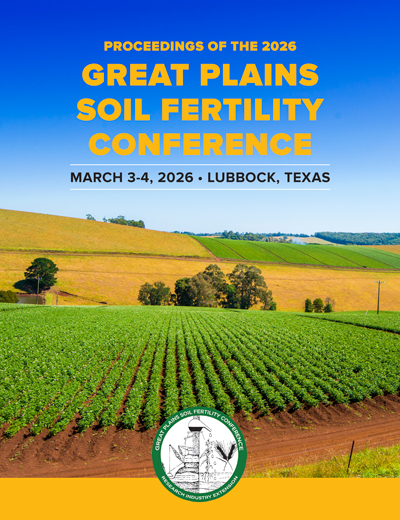
 
The 2026 Great Plains Soil Fertility Conference Proceedings Book is now available! Click the link below to view the full document!
 
2026_GPSFC_Proceedings.pdf

Proceedings

Find matching any: Reset
Armbruster, J
Allen, B
Siebecker, M
Burke, J.A
Ferguson, R
Penas, E
Morrison, M
Schlegel, A
Annis, D
Stewart, W
Porter, D
Cihacek, L
Leikam, D
Patel, S
McDonald, M
Add filter to result:
Authors
Obour, A
Holman, J
Simon, L
Schlegel, A
Haag, L
Schlegel, A
Ruiz Diaz, D
Holman, J
Obour, A
Schlegel, A
Simon, L
Cihacek, L
Alghamdi, R
McDonald, M
DeLaune, P
Gentry, T
Lewis, K
Burke, J.A
Lewis, K.L
Foster, J.L
Haag, L
Tomlinson, P
Patel, S
Santos, E
Haag, L
Patel, S
Tomlinson, P
Santos, E
Topics
Soil Management
N Management
General Posters
Environment and Soil
Nitrogen Management
Type
Oral
Poster
Year
2020
2022
Home » Authors » Results

Authors

Filter results8 paper(s) found.

1. Strategic Tillage Effects on Crop Yield and Soil Properties and Dryland Crop Rotations

This study evaluated strategic tillage (ST) to control HR weeds and improve crop yields in an otherwise long-term no-till (NT) soil. Treatments were five crop rotations: 1) continuous winter wheat (Triticum aestivum L.) (WW); 2) wheat-fallow (WF); 3) wheat-sorghum (Sorghum bicolor L.)-fallow (WSF); 4) continuous sorghum (SS); and 5) sorghum-fallow (SF) as main plots. The sub-plot were reduced tillage (RT), continuous NT, and ST of NT. Results showed tillage (ST or RT)... A. Obour, J. Holman, L. Simon, A. Schlegel

2. In-furrow Placement of Dry Urea Prodcuts with Winter Wheat

Previous research has shown that the application of some nitrogen fertilizer prior to or at the time of wheat seeding can positively affect the initiation of fall tillers and thus yield potential.  However, there are logistical challenges in placing that nitrogen in no-till production systems. Traditionally, the placement of urea-based fertilizers in-furrow with wheat seed has not been recommended.  The objectives of this project were to evaluate stand reduction and associated... L. Haag, A. Schlegel, D. Ruiz diaz

3. Long-term Forage Rotation Yields, Soil Water Use, and Profitability

Forages are important for the region’s livestock industry and are becoming increasingly important as irrigation capacity and grain prices decrease. Forages require less water than grain crops and may allow for increasing cropping system intensification and opportunistic cropping. A study was initiated in 2012 at the Southwest Research-Extension Center near Garden City, KS, comparing several 1-, 3-, and 4-year forage rotations with no-tillage and minimum-tillage. Data presented are from 2013... J. Holman, A. Obour, A. Schlegel, L. Simon

4. N Mineralization Dynamics in No-till Crop Residues in the Northern Plains

Although many studies have been conducted on no-till cropping systems, little is yet known about the dynamics of N mineralization from accumulated crop residues as it relates to providing N to subsequent crops. We conducted incubation studies using individual crop residues placed on the surface of soil columns in leaching tubes and incubating the tubes for approximately 12 weeks (simulated growing season) with periodic leaching.  This was repeated 5 times with a freezing period (winter... L. Cihacek, R. Alghamdi

5. Conservation Management and Nitrogen Fertilization to Enhance Soil Chemical and Biological Properties  

Cover crops and no-tillage are increasing in use across Texas. On the Southern High Plains (SHP) these practices are important mitigators of wind erosion and are suggested to increase soil health and other positive soil attributes. This study aimed to monitor and evaluate the soil chemical and biological changes that occur shortly after implementing conservation practices  and nitrogen management strategies on the SHP. It was determined that in the short term some soil chemical and biological... M. Mcdonald, P. Delaune, T. Gentry, K. Lewis

6. Nutrient Cycling Following Cover Crop Termination in Texas Cotton Production

Cover crop adoption on the Texas High Plains (THP) is severely limited compared to other agricultural regions in the U.S. Cotton producers on the THP consistently site water limitations as the primary reason for not implementing cover crops in their cropping systems. Previous research on the THP has shown that nitrogen immobilization following cover crop termination might be the most leading consequence of cover crops, not water availability. A study was initiated into existing long term... J.A. Burke, K.L. Lewis, J.L. Foster

7. Measuring N2O Emissions from Dryland Sorghum Production Using Gas Chamber and Eddy Covariance Flux Methods

Nitrous oxide (N2O) emissions are not well quantified in the dryland production systems of the Great Plains.  Lack of field-based data has led to the use of questionable assumptions in various life-cycle analyses when dryland grain production is a feedstock.  A field-scale trial of 81 acres was established within a 160 acre production field of dryland grain sorghum in northwest Kansas in 2021.  Grain sorghum was no-till seeded into wheat stubble.  Grower practices for nitrogen... L. Haag, P. Tomlinson, S. Patel, E. Santos

8. Spatial Variability in Profile Soil Nitrate, Nutrient Update, Grain Yield, and Nutrient Removal in a Commercial Dryland Grain Sorghum Field

Established relationships exist that describe the confidence interval around a soil test value as a function of cores in the sample for nutrients such as phosphorus.  This information is useful for developing economically and agronomically optimal soil sampling strategies.  Residual soil nitrate can be a significant source of a crops N needs in dryland cropping systems where N loss is minimal. A common question among producers and consultants is how many profile N cores are required... L. Haag, S. Patel, P. Tomlinson, E. Santos