Conference Proceedings Available!
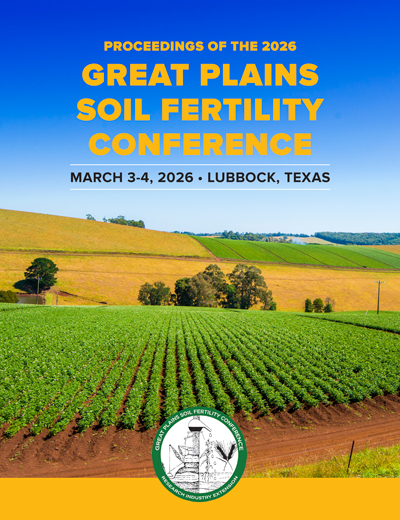
 
The 2026 Great Plains Soil Fertility Conference Proceedings Book is now available! Click the link below to view the full document!
 
2026_GPSFC_Proceedings.pdf

Proceedings

Find matching any: Reset
Kovar, J
Koch, B
Ghimire, D
Kowatch-Carlson, C
Li, Z
Flore, N
Keeling, W
Add filter to result:
Authors
Etemadi, F
Keshavarz Afshar, R
He, H
Zhou, S
Li, Z
Chen, C
Ghimire, D
Maharjan, B
Lim, C
Chen, C
Kowatch-Carlson, C
Franck, B
Gross, T
Brown, R
Ghimire, D
Maharjan, B
Etesami, M
ETEMADI, F
Gross, T
Franck, B
Chen, C
Kowatch-Carlson, C
Franck, S
Burke, J
Lewis, K
Keeling, W
Keeling, W
Wright, A
Burke, J
Lewis, K
Keeling, W
Keeling, W
Topics
Soil Fertility
N Management
General Posters
General
General
Type
Oral
Poster
Year
2020
2022
2024
2026
Home » Authors » Results

Authors

Filter results7 paper(s) found.

1. Effect of Foliar Zinc Application on Durum and Spring Wheat Grain Yield and Quality

Zinc (Zn) deficiency represents a common micronutrient deficiency in human populations, especially in regions of the world where staple food crops are the main source of daily calorie intake. Micronutrients like Zn also plays an important role in growth and development of plant thereby affecting crop yield and quality. A two-year field trial was conducted at Sidney, Montana, to investigate the effect of foliar application of Zn on yield and grain quality of spring wheat. Zinc treatment included... F. Etemadi, R. Keshavarz afshar, H. He, S. Zhou, Z. Li, C. Chen

2. Nitrogen Managememt in Dryland Winter Wheat to Improve Grain Yield and Protein

Maximizing the yield along with adequate protein content in winter wheat is an emerging challenge for dryland wheat producers. Proper nitrogen (N) management with optimization of fertilizer application rate and timing might be a potential strategy to improve grain yield and protein. The objective of the study was to evaluate the effects of different N rates and application timing on grain yield and protein content of hard red winter wheat in Nebraska. Field study was carried out at four locations... D. Ghimire, B. Maharjan

3. Effect of Soil and Foliar Application of Sulfur, Magnesium, Boron, and Zinc on Root Yield and Sugar Quality in Conventional Till and No Till Sugar Beet

Field experiment was conducted at the Eastern Agricultural Research Center in Sidney, MT, to determine the effect of S, Mg, B, and Zn on beet yield and sugar quality under conventional and no-till system. Split-plot design was used with 3.6 x 9.1 m experimental plots and four replicates. Tillage was main plot and micronutrient fertilizer was sub-plot. Tillage treatments included conventional and no-till. Fertilizer treatments included SUL4R-PLUS® (Ca & S), SUL4R-PLUS®B+Zn... C. Lim, C. Chen, C. Kowatch-carlson, B. Franck, T. Gross, R. Brown

4. Sugarbeet Yield Response and Nitrate Leaching As Influenced by Nitrogen Management in Semi-arid Climate

Fertilizer nitrogen (N) in irrigated sugarbeet production needs to be optimized to simultaneously increase yield and reduce nitrate leaching. In addition to adjusting N rate and application timing, there are available fertilizer technologies such as controlled- or slow-release N which may be beneficial for beet yield and reducing potential nitrate leaching. However, there are limited studies assessing the effectiveness of such fertilizers for sugarbeet in a semi-arid climate. The two-year experiment... D. Ghimire, B. Maharjan

5. Nitrogen Fertilizer and Rhizobium Combinations to Improve Yield and Quality of Mung Bean and Adzuki Bean in Montana

Mung bean and adzuki bean are new alternative grain legumes that may be grown in Montana and provide benefits to Montana’s cropping systems by improving long-term diversification and productivity. The objective of this study was to investigate mung bean and adzuki bean response to nitrogen fertilizer and rhizobium combinations to determine the optimum fertilizer management. Two adzuki bean (Organic and O.R varieties) and two mung bean (Organic and L.N varieties) cultivars were grown under... M. Etesami, F. Etemadi, T. Gross, B. Franck, C. Chen, C. Kowatch-carlson, S. Franck

6. Nitrogen Management in Semi-arid Conservation Cotton Production Systems

The Southern High Plains (SHP) region of Texas is one of the largest cotton-producing regions in the United States. Cotton production is hindered by climatic conditions and wind erosion, but attempts have been made to adopt conservation management practices like cover crops and crop rotations to limit these effects. Conservation management practices can reduce a soil’s susceptibility to wind erosion, but their adoption has been limited on the SHP due to producers’ concerns regarding... J. Burke, K. Lewis, W. Keeling, W. Keeling

7. Evaluating the Profitability of Nitrogen Management Strategies to Increase Yield in Regenerative Cotton Production Systems

Soil health management practices, such as cover crops and no-till systems, are common in semi-arid cropping systems to reduce wind erosion. However, implementing these practices can also lower cotton yield. As a result, cotton production using no-till and cover crop systems in semi-arid environments tends to be less profitable than conventional systems, despite lower costs from fewer tillage operations during the growing season. For these soil health practices to be economically sustainable in... A. Wright, J. Burke, K. Lewis, W. Keeling, W. Keeling