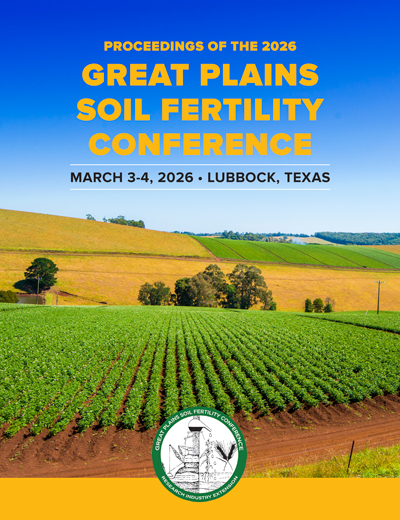
Conference Proceedings Available!

 
The 2026 Great Plains Soil Fertility Conference Proceedings Book is now available! Click the link below to view the full document!
 
2026_GPSFC_Proceedings.pdf

Proceedings

Find matching any: Reset
Frasier, M
Karn, R
Thomas, M
Osborne, S
Khosla, R
Kutcher, R
Foster, A
Simon, L
Garcia Helguera, P
Add filter to result:
Authors
Chim, B
Osborne, S
Lehman, R
Osborne, S
Lehman, R
Riedell, W
Chim, B
Clark, J
Osborne, S
Kovacs, P
Slaght, R
Obour, A
Holman, J
Simon, L
Schlegel, A
Holman, J
Obour, A
Schlegel, A
Simon, L
Simon, L
Obour, A
Holman, J
Roozeboom, K
Sexton, P
Kumar, S
Osborne, S
Brockmueller, B
Bly, A
Rops, B
Bawa, A
Bauder, S
McMaine, J
Mauler, P
Holman , J
Obour , A
Simon, L
Roozeboom , K
Arnall, B
Sawatzky, S
Akin, S
Thomas, M
Singh, R
Raun, W.R
Obour, A
Holman, J
Simon, L
Assefa, Y.M
Karn, R
Guo, W
Lewis, K
Ritchie, G
Siebecker, M
Guo, W
Karn, R
Lewis, K
Simon, L
Obour, A
Holman, J
Johnson, S.K
Obour, A
Carson, Z
Akporsoe, P
Simon, L
Holman, J
Akporsoe, P
Obour, A
Holman, J
Harmoney, K
Carson, Z
Simon, L
Ruiz Diaz, D
Topics
Soil Management
Conservation Impacts on Soil Health
General Posters
General
Student
General
Student
Type
Poster
Oral
Year
2020
2022
2024
2026
Home » Authors » Results

Authors

Filter results15 paper(s) found.

1. Do Legume Cover Crops Help Mineralize Soil Nitrogen?

Nitrogen (N) dynamic is dependent on multiple factor all of which influence in-season plant N availability.  Inclusion of a cover crop can have additional impacts on N dynamic by utilizing fall residue soil N, reducing the potential of N leaching.  Legume cover crops also have the potential to add additional N to the soil through N fixation.  The objective of this study was to evaluate N dynamic of different cover crops (legume and nonlegume) compared to no cover... B. Chim, S. Osborne, R. Lehman

2. Long-term Crop Rotation Impact on Soil Properties and Crop Response

Crop rotations can be part of sustainable agriculture production by their effectiveness depends on understanding how crop rotations affect above- and below-ground crop characteristics. Objectives were to investigate crop rotation effects on shoot dry weight and root characteristics of cereal and grain legume crops at anthesis as well as on grain yield. Rotations were corn (Zea mays L.)-soybean [Glycine max (L.) Merr.], (CS); corn-soybean-spring wheat (Triticum aestivum L.)-field... S. Osborne, R. Lehman, W. Riedell, B. Chim

3. Inter-seeding Cover Crops Influence on Optimal Corn Nitrogen Rate in No-till

Moving from conventional to no-till with the inclusion of cover crops may change the amount and timing of nitrogen (N) provided to corn (Zea mays L.) from mineralization, which may increase or decrease needed N fertilizer to optimize corn grain yield. This study evaluated the effect of cover crop composition on corn N fertilizer requirement and corn grain yield. The effect of three cover crop treatments (no cover crop, single grass species, and grass/broadleaf mixture) on corn... J. Clark, S. Osborne, P. Kovacs, R. Slaght

4. Strategic Tillage Effects on Crop Yield and Soil Properties and Dryland Crop Rotations

This study evaluated strategic tillage (ST) to control HR weeds and improve crop yields in an otherwise long-term no-till (NT) soil. Treatments were five crop rotations: 1) continuous winter wheat (Triticum aestivum L.) (WW); 2) wheat-fallow (WF); 3) wheat-sorghum (Sorghum bicolor L.)-fallow (WSF); 4) continuous sorghum (SS); and 5) sorghum-fallow (SF) as main plots. The sub-plot were reduced tillage (RT), continuous NT, and ST of NT. Results showed tillage (ST or RT)... A. Obour, J. Holman, L. Simon, A. Schlegel

5. Long-term Forage Rotation Yields, Soil Water Use, and Profitability

Forages are important for the region’s livestock industry and are becoming increasingly important as irrigation capacity and grain prices decrease. Forages require less water than grain crops and may allow for increasing cropping system intensification and opportunistic cropping. A study was initiated in 2012 at the Southwest Research-Extension Center near Garden City, KS, comparing several 1-, 3-, and 4-year forage rotations with no-tillage and minimum-tillage. Data presented are from 2013... J. Holman, A. Obour, A. Schlegel, L. Simon

6. Long-term Cover Crop Effects on Soil Organic Carbon, Nitrogen Stocks, and Water Stable Aggregates in the Semiarid Central Great Plains

Growing cover crops (CC) in semiarid dryland cropping systems in the central Great Plains (CGP) may provide several benefits to soil health. This study examined long-term CC management effects on soil health in a no-till winter wheat (Triticum aestivum L.)–grain sorghum (Sorghum bicolor L.)–fallow (WSF) cropping system in southwestern Kansas. The experimental design was a split-split-plot randomized complete block with four replications. Main plots were... L. Simon, A. Obour, J. Holman, K. Roozeboom

7. Snapshot of Crop Nutrient Balance with Use of a Rye Cover Crop in a Corn-soybean Rotation Under Tile Drainage in Eastern South Dakota

The purpose of this study was to evaluate the effect of using a winter rye cover crop within a corn/soybean rotation (rye seeded every fall and burned down each spring) on drainage water quality, crop nutrient status, and grain yield.  Use of a winter rye cover crop to take up available N from the soil profile is a management tool that may help to lessen nutrient movement out of the soil profile while at the same time contributing to improved soil health.  Winter rye is very winter hardy... P. Sexton, S. Kumar, S. Osborne, B. Brockmueller, A. Bly, B. Rops, A. Bawa, S. Bauder, J. Mcmaine

8. Soil Properties Affected by Grazing and Tillage of Annual Forages

No-till (NT) management of annual crop production systems increases precipitation capture and storage. However, compaction with annual livestock grazing and the development of herbicide resistant weeds present challenges to long-term NT. An on-farm study was established in 2016 near Jetmore, KS to investigate the influence of annual tillage with a sweep plow compared to NT in a grazed continuous winter triticale production system. Forage productivity as well as weed density and soil properties... P. Mauler, J. Holman , A. Obour , L. Simon, K. Roozeboom

9. Effect of Rate and Timing of Nitrogen Applications on Forage Sorghum Biomass Yield

Forage Sorghum (Sorghum-Sudan grass) is a forage crop harvested in the form of silage or dry-hay and is intended to distribute to livestock as feed. The research objective for this study is to observe how nitrogen timing plays a role in crop total biomass yield. Observations and data were collected during the 2021 growing season, with a total of two harvests allowed due to weather conditions in the area. This trial was conducted at two locations: Lake Carl Blackwell near Stillwater, Oklahoma and... B. Arnall, S. Sawatzky, S. Akin, M. Thomas, R. Singh, W.R. Raun

10. Soil Properties and Winter Wheat Nutrient Uptake As Affected by Long-term Tillage and Nitrogen Fertilization

Knowledge gained on the long-term effects of crop management practices on soil fertility is critical in developing nutrient management strategies to optimize crop yields and environmental sustainability in semi-arid cropping systems. This study examined the long-term effects of nitrogen (N) fertilizer management and tillage intensity [conventional tillage (CT), and no-tillage (NT)] on soil properties and nutrient uptake in a dryland wheat-sorghum-fallow cropping system. Results showed winter wheat... A. Obour, J. Holman, L. Simon, Y.M. Assefa

11. Temporal and Spatial Variability of Nitrogen Use Efficiency Across Landscape Positions in Southern High Plains

Optimizing nitrogen use efficiency (NUE) is crucial for enhancing crop productivity, managing resources effectively, and promoting environmental sustainability. In response to the growing significance of sustainable agriculture, this research rigorously explores the temporal and spatial dynamics of NUE in the unique agroecosystem of the Southern High Plains. With a focus on precision nitrogen management tailored to the region's distinctive conditions, the study aims to provide valuable insights... R. Karn, W. Guo, K. Lewis, G. Ritchie, M. Siebecker

12. Advancing Precision Nitrogen Management in Agriculture: a Multifaceted Approach

Advancing precision nitrogen management in agriculture involves achieving a balance between maximizing crop yield and minimizing environmental impact. Traditional nitrogen management approaches often lead to inefficiencies, contributing to environmental issues such as nitrous oxide emissions and nitrogen runoff. Significant challenges persist in quantifying factors influencing nitrogen dynamics in the soil-plant-atmosphere system, including landscape positions, soil properties, weather patterns,... W. Guo, R. Karn, K. Lewis

13. Post-wheat Summer Cover Crop Effects Crop Yields and Soil Properties in a No-till Dryland Cropping System

Traditional dryland cropping systems in the semi-arid Great Plains include long fallow periods of up to 14 months to conserve soil moisture. However, such systems are inefficient even under continuous no-till (NT) management. As less water is necessary to produce forage compared to grain, cover crops (CCs) may be successfully integrated into dryland crop rotations for increased soil cover and potentially greater income when hayed or grazed as annual forages. One study was initiated in 2016 near... L. Simon, A. Obour, J. Holman, S.K. Johnson

14. Cover Crop Planting Time Effects on Biomass Productivity, Soil Health and Wheat Yield in Dryland Systems

Ecosystems benefits of cover crops (CCs) in semi-arid dryland cropping systems are dependent on CC biomass productivity. This study evaluated how CC planting time (spring vs. fall) and fallow management practices [no-tillage (NT) vs. occasional tillage (OT)] influenced CC biomass, surface residue, selected soil health properties and crop yields in within a winter wheat (Triticum aestivum L.)-sorghum (Sorghum bicolor Moench)–fallow (WSF) rotation. The experiment was conducted from... A. Obour, Z. Carson, P. Akporsoe, L. Simon, J. Holman

15. Short-Term Changes in Soil Properties Following Simulated Wildfire After Winter Wheat Harvest

Wildfires on croplands can destroy residue cover, soil organic matter and negatively impact crops yields in semi-arid Great. Approximately 16 acre field of winter wheat stubble was subjected to wildfire event at Kansas State University Agricultural Research Center near Hays, KS  to study management strategies that can restore soil health in croplands impacted by wildfires.  Control burning to stimulated wildfire was done in summer 2025 by igniting fire on a down-wind corner at the interface... P. Akporsoe, A. Obour, J. Holman, K. Harmoney, Z. Carson, L. Simon, D. Ruiz diaz