Conference Proceedings Available!
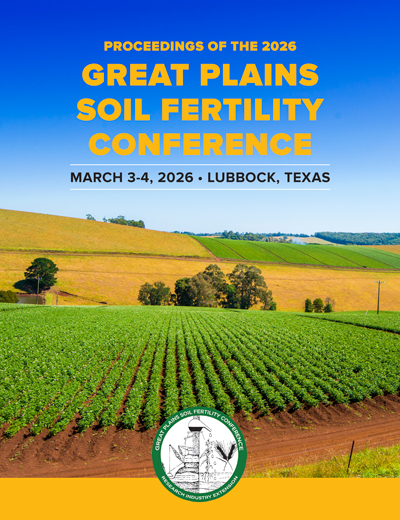
Proceedings
Authors
| Filter results6 paper(s) found. |
|---|
1. Phosphorus Fertilizer Management and Cover Crop Effects on Phosphorus Loss from No-till Corn and Soybean.Loss of phosphorus from non-point source agricultural sources is a known contributor to the degradation and contamination of surface waters. Therefore, it is imperative to adapt agricultural best management practices which promote and preserve surface water quality. The goal of this study was to quantify the impacts of phosphorus fertilizer management practice (placement and timing) and winter cover crop on concentrations of total suspended solids, total phosphorus, and dissolved reactive phosphorus... E. Carver, N. Nelson, K. Roozeboom, G. Kluitenberg, P. Tomlinson, J. Williams |
2. Temporal and Spatial Variability of Nitrogen Use Efficiency Across Landscape Positions in Southern High PlainsOptimizing nitrogen use efficiency (NUE) is crucial for enhancing crop productivity, managing resources effectively, and promoting environmental sustainability. In response to the growing significance of sustainable agriculture, this research rigorously explores the temporal and spatial dynamics of NUE in the unique agroecosystem of the Southern High Plains. With a focus on precision nitrogen management tailored to the region's distinctive conditions, the study aims to provide valuable insights... R. Karn, W. Guo, K. Lewis, G. Ritchie, M. Siebecker |
3. Nitrogen Management in Semi-arid Conservation Cotton Production SystemsThe Southern High Plains (SHP) region of Texas is one of the largest cotton-producing regions in the United States. Cotton production is hindered by climatic conditions and wind erosion, but attempts have been made to adopt conservation management practices like cover crops and crop rotations to limit these effects. Conservation management practices can reduce a soil’s susceptibility to wind erosion, but their adoption has been limited on the SHP due to producers’ concerns regarding... J. Burke, K. Lewis, W. Keeling, W. Keeling |
4. Advancing Precision Nitrogen Management in Agriculture: a Multifaceted ApproachAdvancing precision nitrogen management in agriculture involves achieving a balance between maximizing crop yield and minimizing environmental impact. Traditional nitrogen management approaches often lead to inefficiencies, contributing to environmental issues such as nitrous oxide emissions and nitrogen runoff. Significant challenges persist in quantifying factors influencing nitrogen dynamics in the soil-plant-atmosphere system, including landscape positions, soil properties, weather patterns,... W. Guo, R. Karn, K. Lewis |
5. Investigating Adsorption Capacities of Treated Sewage Byproducts for Their Potential Use As FertilizerAs the global population rapidly grows, food producers of the world are faced with the task of feeding as many as ten billion people by 2050. The current state of fertilizer use cannot support this growth, and the overuse and poor management of fertilizers has degraded soil, water, and air quality over time. The average recovery efficiency of nitrogen by crops is low, only 50% due to the fast dispersion/loss of applied fertilizers to the environment. This leaching of fertilizer often leads to... K. Coyle, L. Slaughter, C. Alvarez-pugliese, G.G. Botte, M. Siebecker |
6. Shining Light on Novel Pathways for Potassium Fixation in SoilCotton has a high demand for potassium, and potassium significantly affects both cotton yield and fiber quality. Thus, bioavailability of potassium from the soil is paramount. Bioavailability and leaching of potassium to crops and from soils has been studied since the 1940s. However, problems that confronted agronomists in the 1980s continue to impact growers and crop production, including unpredictable potassium bioavailability and inconsistent plant response to fertilizer application under a... M. Siebecker, K. Coyle, T. Pham, I. Saldana haworth, E. Schmidt, A. Sharma, K. Lewis |
