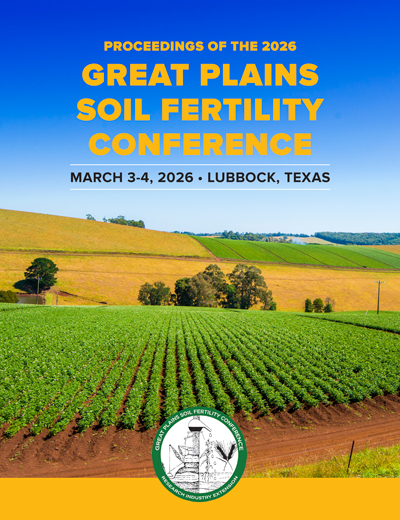
Conference Proceedings Available!

 
The 2024 Great Plains Soil Fertility Conference Proceedings Book is now available! Click the link below to view the full document!
 
GPSFC Proceedings - 2024.pdf

Proceedings

Find matching any: Reset
Bean, B
Leichty, S
Maharjan, B
Thompson, C
Stichler, C
Ferdinand, L
Pinchak, W
D'Adamo, R
Truman, C
Berrada, A
Schweeissing, F
Miner, G.L
Lyon, D
Shapiro, C
Presley, D
Ritchie, G
Kowatch-Carlson, C
Thomason, W
Add filter to result:
Authors
Delgado, J.A
Halvorson, A
Villacis-Aveiga, A
Del Grosso, S
Stewart, C
Manter, D
Alwang, J
Floyd, B
D'Adamo, R
Miner, G
Oleszak, H
Cotrufo, F
Leichty, S
Stewart, C
Maharjan, B
Qiao, X
Ghimire, D
Maharjan, B
Panday, D
Maharjan, B
Eash, L
Berrada, A
Russell, K
Fonte, S
Pabuayon, I.B
Ritchie, G
Lewis, K
Bumguardner, A
Lewis, K
Ritchie, G
Bronson, K
Maeda, M
Delgado, J.A
Floyd, B
D'Adamo, R
Villacis, A
Brandt, A.D
Halvorson, A
Stewart, C.E
Alwang, J
Del Grosso, S
Manter, D.K
Lim, C
Chen, C
Kowatch-Carlson, C
Franck, B
Gross, T
Brown, R
Stewart, C.E
Jin, V.L
Schmer, M.R
Mitchell, R.B
Williams, C
Miner, G.L
Ghimire, D
Maharjan, B
Maharjan, B
DeSilva, S
Etesami, M
ETEMADI, F
Gross, T
Franck, B
Chen, C
Kowatch-Carlson, C
Franck, S
Karn, R
Guo, W
Lewis, K
Ritchie, G
Siebecker, M
Lewis, K
Valencia, H
Roberts, T
Burke, J
Ritchie, G
Correira, A
Grunberg, J
Tomlinson, P
Roozeboom, K
Presley, D
Pabuayon, I
Lewis, K
Ritchie, G
Bicaldo, J
Lewis, K
Ritchie, G
Topics
N/Irrigation
N Management
General Posters
Environment and Soil
Conservation Impacts on Soil Health
General
Student
Type
Oral
Poster
Year
2020
2022
2024
Home » Authors » Results

Authors

Filter results19 paper(s) found.

1. Assessment of Long-term Effects of Tillage and Nitrogen Management Practices on Irrigated Corn Yields and Nitrogen Use Efficiencies

Corn grain yields and crop nitrogen uptake are affected by management factors such as tillage intensity and nitrogen rates. Additional data about the long-term effects of tillage and nitrogen rates on yields and nitrogen use efficiencies of irrigated corn are needed. We are presenting preliminary results from a 17-year study about the effects of these management practices on irrigated corn yields and nitrogen uptake in a Fort Collins clay loam soil at Colorado State University’s Agricultural... J.A. Delgado, A. Halvorson, A. Villacis-aveiga, S. Del grosso, C. Stewart, D. Manter, J. Alwang, B. Floyd, R. D'adamo, G. Miner

2. Effects of Residue Placement on Co2 Loss in an Irrigated, No-till Corn System

It is well known that residue management practices that leave crop residue on the surface, such as no-till agriculture, promote soil fertility. However, the effects of such practices on carbon sequestration can be highly variable. To better understand how residue management impacts the loss of carbon through mineralization, we investigated the effects of residue location and addition on CO2 produced from residue decomposition under no-till irrigated continuous corn in Northern Colorado. Over... H. Oleszak, F. Cotrufo, S. Leichty, C. Stewart

3. Fall and Spring Soil Residual Nitrate-n As Affected by Irrigation and Nitrogen Management

Nitrogen credit from residual nitrate-N from soil samples collected in spring is widely considered and accounted for in managing N in crop production. That is important from both economic and environmental perspectives. However, there is no incentives for farmers to determine post-harvest soil residual nitrate-N in fall. It is important to note that any difference in fall and spring soil residual nitrate-N would suggest environmental N losses via denitrification or leaching in that fallow period.... B. Maharjan, X. Qiao

4. Nitrogen Managememt in Dryland Winter Wheat to Improve Grain Yield and Protein

Maximizing the yield along with adequate protein content in winter wheat is an emerging challenge for dryland wheat producers. Proper nitrogen (N) management with optimization of fertilizer application rate and timing might be a potential strategy to improve grain yield and protein. The objective of the study was to evaluate the effects of different N rates and application timing on grain yield and protein content of hard red winter wheat in Nebraska. Field study was carried out at four locations... D. Ghimire, B. Maharjan

5. Does Coal Char Reduce Ammonia Volatilization by Slowing Urea Hydrolysis in Soil?

Ammonia volatilization due to urea hydrolysis begins immediately after N fertilizer applied in soil and continues up to two weeks. This process might adversely affect N availability in soil/ plant systems and reduce soil fertility and crop yields, as well as bring the negative impact in environment. Char, incomplete burning of coal combustion residue which contains up to 30% total C by weight, is hypothesized to reduce N losses from ammonia volatilization. A 21-day laboratory study was conducted... D. Panday, B. Maharjan

6. Evaluating the Trade-offs of Cover Crops in Dryland Wheat Systems of the Colorado Plateau

On the semi-arid Colorado Plateau, dryland farmers are challenged by severely degraded soils and low and increasingly unreliable precipitation. Cover crops have been shown to improve soil fertility and mitigate soil erosion in many regions, but are also associated with use of limited soil moisture, a cost that could mean decreased cash crop productivity for farmers. Most literature on cover crops comes from relatively humid climates, where crop yield penalties due to cover crops may be less pronounced.... L. Eash, A. Berrada, K. Russell, S. Fonte

7. Nutrient Partitioning Changes in the Past 30 Years of Cotton Production

Modern cotton (Gossypium hirsutum L.) cultivars are more compact and efficient due to optimization of genetics and changed management practices in the past 30 years. The most recent work evaluating nutrient uptake by cotton was done in early 1990s, hence a need to re-evaluate the nutrient accumulation and requirements in modern high productivity cultivars. The objective of this study was to compare the resource allocation of modern cotton cultivars (PM HS26, FM 958, and DP 1646)... I.B. Pabuayon, G. Ritchie, K. Lewis

8. Relationship Between Plant Nitrogen and NDVI of Cotton on the Texas High Plains

Nitrogen (N) is one of the most limiting factors in Texas High Plains cotton production (Bronson et al., 2001). Nitrogen build-up in cotton is near maximum for the season at first open boll, when leaf senescence begins (Li et al., 2001). Lint yield response to N is difficult to predict due to N response relying on water management and initial soil nitrate (NO3--N) (Morrow and Krieg, 1990). Normalized difference vegetative index (NDVI) is a tool that has been used to manage... A. Bumguardner, K. Lewis, G. Ritchie, K. Bronson, M. Maeda

9. Effects of Climate Change and Narrow Rows with Higher Plant Densities on Yields of Irrigated Corn

Climate change is significantly impacting agricultural systems worldwide, and although there are reports of these impacts contributing to higher yields in some regions, the general consensus is that there will be negative impacts on yields and soil quality across large regions.  Management practices that can contribute to higher yields and adaptation to a changing climate will be important during the 21st century. This presentation will cover results from two manuscripts that are currently... J.A. Delgado, B. Floyd, R. D'adamo, A. Villacis, A.D. Brandt, A. Halvorson, C.E. Stewart, J. Alwang, S. Del grosso, D.K. Manter

10. Effect of Soil and Foliar Application of Sulfur, Magnesium, Boron, and Zinc on Root Yield and Sugar Quality in Conventional Till and No Till Sugar Beet

Field experiment was conducted at the Eastern Agricultural Research Center in Sidney, MT, to determine the effect of S, Mg, B, and Zn on beet yield and sugar quality under conventional and no-till system. Split-plot design was used with 3.6 x 9.1 m experimental plots and four replicates. Tillage was main plot and micronutrient fertilizer was sub-plot. Tillage treatments included conventional and no-till. Fertilizer treatments included SUL4R-PLUS® (Ca & S), SUL4R-PLUS®B+Zn... C. Lim, C. Chen, C. Kowatch-carlson, B. Franck, T. Gross, R. Brown

11. Soil Carbon and Agroecosystem Benefits of Conservation Management and Perennial Bioenergy Crop Production

Conservation agricultural management practices and perennial bioenergy crops can increase soil organic C (SOC) stocks on marginal soils yet the time necessary to observe these benefits, as well as the upper limit of C storage isn’t known. Co-benefits often associated with SOC accumulation are positive effects on water and nutrient retention, soil microbial biomass and diversity and soil structure, resulting in better soil quality. However, interactions between nitrogen fertilizer, crop biochemistry,... C.E. Stewart, V.L. Jin, M.R. Schmer, R.B. Mitchell, C. Williams, G.L. Miner

12. Sugarbeet Yield Response and Nitrate Leaching As Influenced by Nitrogen Management in Semi-arid Climate

Fertilizer nitrogen (N) in irrigated sugarbeet production needs to be optimized to simultaneously increase yield and reduce nitrate leaching. In addition to adjusting N rate and application timing, there are available fertilizer technologies such as controlled- or slow-release N which may be beneficial for beet yield and reducing potential nitrate leaching. However, there are limited studies assessing the effectiveness of such fertilizers for sugarbeet in a semi-arid climate. The two-year experiment... D. Ghimire, B. Maharjan

13. Effects of Fertilizer Nitrogen Management on Biomass, Oil, and Nitrous Oxide Emissions in Peppermint in Nebraska Panhandle

Peppermint (Mentha pipperita) is an aromatic perennial herb that contains aromatic oil, primarily menthol. Irrigated peppermint production requires large nitrogen (N) input, which is often higher than for irrigated corn. Therefore, if not managed properly, mint production has a high potential for N losses, including nitrous oxide (N2O) emissions. Nitrous oxide is a major greenhouse gas and the most important ozone-depleting emission. Increasing N2O emissions from... B. Maharjan, S. Desilva

14. Nitrogen Fertilizer and Rhizobium Combinations to Improve Yield and Quality of Mung Bean and Adzuki Bean in Montana

Mung bean and adzuki bean are new alternative grain legumes that may be grown in Montana and provide benefits to Montana’s cropping systems by improving long-term diversification and productivity. The objective of this study was to investigate mung bean and adzuki bean response to nitrogen fertilizer and rhizobium combinations to determine the optimum fertilizer management. Two adzuki bean (Organic and O.R varieties) and two mung bean (Organic and L.N varieties) cultivars were grown under... M. Etesami, F. Etemadi, T. Gross, B. Franck, C. Chen, C. Kowatch-carlson, S. Franck

15. Temporal and Spatial Variability of Nitrogen Use Efficiency Across Landscape Positions in Southern High Plains

Optimizing nitrogen use efficiency (NUE) is crucial for enhancing crop productivity, managing resources effectively, and promoting environmental sustainability. In response to the growing significance of sustainable agriculture, this research rigorously explores the temporal and spatial dynamics of NUE in the unique agroecosystem of the Southern High Plains. With a focus on precision nitrogen management tailored to the region's distinctive conditions, the study aims to provide valuable insights... R. Karn, W. Guo, K. Lewis, G. Ritchie, M. Siebecker

16. Developing Nitrogen and Phosphorus Fertigation Strategies in Cotton

Subsurface drip irrigation (SDI) is becoming a popular option for maximizing the water use efficiency of cotton (Gossypium hirsutum), especially in semi-arid environments of the Midsouth and Western United States. In the Texas High Plains where underground water resources from the Ogallala Aquifer are rapidly declining, there is increased adoption of water conservation technologies like center pivot and drip irrigation. In addition to increased water efficiency, drip irrigation allows... K. Lewis, H. Valencia, T. Roberts, J. Burke, G. Ritchie

17. Assessing Corn Response to Cover Crops and Nitrogen Fertilization in a No –Till, Three-year Rotation in Northeast Kansas

As industry initiatives and government programs begin funding and incentivizing climate-smart agricultural practices, more farmers in the great plains region may be interested in incorporating cover crops into their rotations. Annual yield data can aid in understanding how cover crops impact cash crop productivity in this region. A long-term cover crop experiment in northeast Kansas was established in 2007 based on a wheat – corn – soybean rotation to determinate the... A. Correira, J. Grunberg, P. Tomlinson, K. Roozeboom, D. Presley

18. Comparative Analysis of Resource Partitioning and Nutrient Uptake Efficiencies in Modern Cotton Cultivars

Understanding the complex process of resource partitioning within the plant provides prospects to develop new crop improvement strategies for varying environmental factors and agronomic practices. In upland cotton, the partitioning of dry matter is as crucially important as that of macronutrients and micronutrients in improving productivity. This presentation highlights research works pertaining to the changes in macronutrient and micronutrient uptake and partitioning alongside the remarkable... I. Pabuayon, K. Lewis, G. Ritchie

19. Evaluation of the Nutrient Requirements and Uptake Indices of Ten Modern Cotton Cultivars

This study aims to re-evaluate the partitioning patterns and nutrient uptake index of new and soon-to-be released cotton cultivars to optimize the nutrient inputs for farmers and producers. The study will be divided into two phases: Phase I will be the determination of different nutrient uptake indices of 10 modern cotton cultivars and Phase II will be the development and establishment of new fertilizer management strategies for modern cotton cultivars using the results of plant nutrient uptake... J. Bicaldo, K. Lewis, G. Ritchie