Conference Proceedings Available!
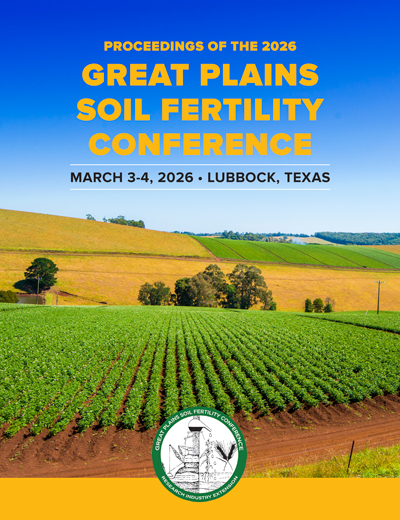
 
The 2024 Great Plains Soil Fertility Conference Proceedings Book is now available! Click the link below to view the full document!
 
GPSFC Proceedings - 2024.pdf

Proceedings

Find matching any: Reset
Wheeler, T
Li, Z
Reich, R
Burgener, P
Schoenau, J
Burke, J
Schroeder, P
Schlegel, A
Westfall, D
Keeling, W
Schwartz, R
Thomas, M
Menkhaus, D
Martin, K
Raun, W.R
Franck, W
Malapati, A
McLaughlin, M
Add filter to result:
Authors
Sutradhar, A
Franck, W
Garza, R
Chen, C
Etemadi, F
Keshavarz Afshar, R
He, H
Zhou, S
Li, Z
Chen, C
Obour, A
Holman, J
Simon, L
Schlegel, A
Haag, L
Schlegel, A
Ruiz Diaz, D
Holman, J
Obour, A
Schlegel, A
Simon, L
Bumguardner, A
Wheeler, T
Lewis, K
Burke, J
Kelley, D
Lewis, K
Thomas, M
Arnall, B
Arnall, B
Sawatzky, S
Akin, S
Thomas, M
Singh, R
Raun, W.R
Burke, J
Lewis, K
DeLaune, P
Weiseth, B
Schoenau, J
Elliott, J
Valencia, H
Burke, J
Roberts, T
Lewis, K
Burke, J
Lewis, K
Keeling, W
Keeling, W
Lewis, K
Valencia, H
Roberts, T
Burke, J
Ritchie, G
Lewis, K
Babcock, R
Burke, J
Cobos, C
Topics
N/Irrigation
Soil Fertility
Soil Management
N Management
General Posters
Conservation Impacts on Soil Health
Student
General
Type
Oral
Poster
Year
2020
2022
2024
Home » Authors » Results

Authors

Filter results15 paper(s) found.

1. Tillage and Nitrogen Management for Irrigated Sugarbeet Production in Eastern Montana

Sugar beet (Beta vulgaris L.) is an important cash crop in the Lower Yellowstone River region. Nitrogen management is very critical while farmers are transitioning sugar beet production from conventional tillage to no-till system. The objectives of this study were to: (i) evaluate the effects of fertilizer-N rate and application timing on sugar beet root yield, sugar content, and quality under conventional and no-till managements, (ii) determine N uptake and N use efficiency (NUE)... A. Sutradhar, W. Franck, R. Garza, C. Chen

2. Effect of Foliar Zinc Application on Durum and Spring Wheat Grain Yield and Quality

Zinc (Zn) deficiency represents a common micronutrient deficiency in human populations, especially in regions of the world where staple food crops are the main source of daily calorie intake. Micronutrients like Zn also plays an important role in growth and development of plant thereby affecting crop yield and quality. A two-year field trial was conducted at Sidney, Montana, to investigate the effect of foliar application of Zn on yield and grain quality of spring wheat. Zinc treatment included... F. Etemadi, R. Keshavarz afshar, H. He, S. Zhou, Z. Li, C. Chen

3. Strategic Tillage Effects on Crop Yield and Soil Properties and Dryland Crop Rotations

This study evaluated strategic tillage (ST) to control HR weeds and improve crop yields in an otherwise long-term no-till (NT) soil. Treatments were five crop rotations: 1) continuous winter wheat (Triticum aestivum L.) (WW); 2) wheat-fallow (WF); 3) wheat-sorghum (Sorghum bicolor L.)-fallow (WSF); 4) continuous sorghum (SS); and 5) sorghum-fallow (SF) as main plots. The sub-plot were reduced tillage (RT), continuous NT, and ST of NT. Results showed tillage (ST or RT)... A. Obour, J. Holman, L. Simon, A. Schlegel

4. In-furrow Placement of Dry Urea Prodcuts with Winter Wheat

Previous research has shown that the application of some nitrogen fertilizer prior to or at the time of wheat seeding can positively affect the initiation of fall tillers and thus yield potential.  However, there are logistical challenges in placing that nitrogen in no-till production systems. Traditionally, the placement of urea-based fertilizers in-furrow with wheat seed has not been recommended.  The objectives of this project were to evaluate stand reduction and associated... L. Haag, A. Schlegel, D. Ruiz diaz

5. Long-term Forage Rotation Yields, Soil Water Use, and Profitability

Forages are important for the region’s livestock industry and are becoming increasingly important as irrigation capacity and grain prices decrease. Forages require less water than grain crops and may allow for increasing cropping system intensification and opportunistic cropping. A study was initiated in 2012 at the Southwest Research-Extension Center near Garden City, KS, comparing several 1-, 3-, and 4-year forage rotations with no-tillage and minimum-tillage. Data presented are from 2013... J. Holman, A. Obour, A. Schlegel, L. Simon

6. Optimizing Irrigation and Fertilizer Management in Cotton to Increase Nitrogen Use Efficiency

Nitrogen (N) fertilizer is an important nutrient in cotton production, and if the optimal amount is not applied yield penalty may occur (Hutmacher et al. 2004). A more efficient application of N fertilizer based on plant N requirements, soil texture, and N availability can increase cotton yield and N-use efficiency (NUE). The main objective of this research was to determine the relationship between cotton lint yield and normalized difference vegetation index (NDVI) across multiple irrigation levels,... A. Bumguardner, T. Wheeler, K. Lewis

7. Nitrogen Management in Conservation Systems to Increase Use Efficiency and Cotton Production

Conservation management practices like no-tillage and cover crops have the potential to reduce wind erosion and stimulate ecosystem service, but lingering doubts regarding nutrient immobilization and water usage may limit their adoption on the Texas High Plains. A study was initiated at the Agricultural Complex for Advanced Research and Extension Systems (AG-CARES) in Lamesa, TX to examine the impact of supplemental nitrogen (N) fertilization on cotton yields and nitrogen use efficiency (NUE)... J. Burke, D. Kelley, K. Lewis

8. Evaluation of Starter Nitrogen Fertilizer Rates for Grain Sorghum Production in the Southern Great Plains

Nitrogen (N) is the most essential nutrient for plant growth and is often the most limiting in crop production. Timely applications of N throughout the growing season are critical to maximizing crop yield. Applying N at planting has proven to be an effective practice, giving plants accessible N early on to increase vegetative growth. Although this is commonly practiced in corn production throughout the Oklahoma and Kansas area, little research has been conducted concerning proper N starter rates... M. Thomas, B. Arnall

9. Effect of Rate and Timing of Nitrogen Applications on Forage Sorghum Biomass Yield

Forage Sorghum (Sorghum-Sudan grass) is a forage crop harvested in the form of silage or dry-hay and is intended to distribute to livestock as feed. The research objective for this study is to observe how nitrogen timing plays a role in crop total biomass yield. Observations and data were collected during the 2021 growing season, with a total of two harvests allowed due to weather conditions in the area. This trial was conducted at two locations: Lake Carl Blackwell near Stillwater, Oklahoma and... B. Arnall, S. Sawatzky, S. Akin, M. Thomas, R. Singh, W.R. Raun

10. Soil Health and Cotton Production in the Semi-arid Texas High Plains

Soil health has become a ubiquitous term in agriculture, but little is known about the impact of cropping system management on soil health metrics in semi-arid regions because of the majority of research has been conducted in humid or sub-humid regions of the United States. As a leading commodity of the semi-arid Southwest, cotton is an ideal candidate for soil health review. The purpose of this study was to assess a proposed set of soil health metrics in cotton production on the semi-arid Texas... J. Burke, K. Lewis, P. Delaune

11. Impact of Fertilizer Phosphorus (P) Source, Rate, and Placement Strategy on Yield, Nutrient Uptake, and P Losses in Snowmelt Runoff Water Across Variable Topographies in Saskatchewan, Canada

The plant availability and mobility in soil of a fertilizer phosphorus (P) source is influenced by the solubility of the fertilizer product itself as well as the reaction products formed in soil over time. In 2021, 2022 and 2023, responses of wheat, pea and canola yield, P uptake and recovery were determined using eight fertilizer P sources applied in a broadcast and incorporate or side-band placement strategy at a low and high (20 vs 40 kg P2O5 ha-1) rates in... B. Weiseth, J. Schoenau, J. Elliott

12. Subsurface Drip Fertigation Impacts on Nutrient Uptake and Partitioning in Cotton

Subsurface drip irrigation (SDI) is becoming a popular option for maximizing the water use efficiency of cotton (Gossypium hirsutum), especially in semi-arid environments of the Midsouth and Western United States. In the Texas High Plains where underground water resources from the Ogallala Aquifer are rapidly declining, there is increased adoption of water conservation technologies like center pivot and drip irrigation. In addition to increased water efficiency, drip irrigation allows... H.L. Valencia, J. Burke, T. Bennett, K. Lewis

13. Nitrogen Management in Semi-arid Conservation Cotton Production Systems

The Southern High Plains (SHP) region of Texas is one of the largest cotton-producing regions in the United States. Cotton production is hindered by climatic conditions and wind erosion, but attempts have been made to adopt conservation management practices like cover crops and crop rotations to limit these effects. Conservation management practices can reduce a soil’s susceptibility to wind erosion, but their adoption has been limited on the SHP due to producers’ concerns regarding... J. Burke, K. Lewis, W. Keeling, W. Keeling

14. Developing Nitrogen and Phosphorus Fertigation Strategies in Cotton

Subsurface drip irrigation (SDI) is becoming a popular option for maximizing the water use efficiency of cotton (Gossypium hirsutum), especially in semi-arid environments of the Midsouth and Western United States. In the Texas High Plains where underground water resources from the Ogallala Aquifer are rapidly declining, there is increased adoption of water conservation technologies like center pivot and drip irrigation. In addition to increased water efficiency, drip irrigation allows... K. Lewis, H. Valencia, T. Roberts, J. Burke, G. Ritchie

15. Sustainable and Resilient Cropping Systems to Mitigate Wind Erosion for the Enhancement of Human Health

In the Texas High Plains, regenerative cropping practices in a predominantly conventional farming area can be used to prevent further depletion of topsoil by wind erosion. This loss of topsoil can cause a decrease in agricultural productivity and form dust storms that can be detrimental to human health causing a rise in hospitalizations of chronic lung damage, cardiovascular disorders, and diseases contracted by inhalation. Using regenerative farming practices, both the number and size of dust... K. Lewis, R. Babcock, J. Burke, C. Cobos