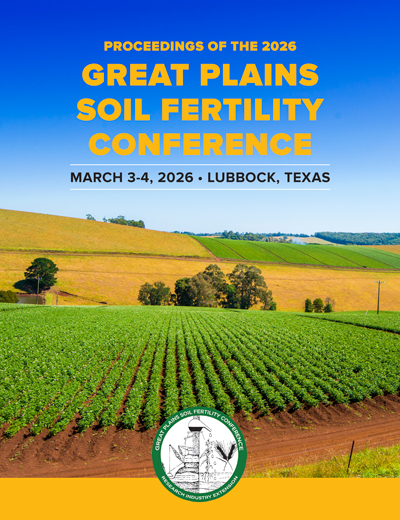
Conference Proceedings Available!
Proceedings
Authors
| Filter results14 paper(s) found. |
|---|
1. Observational and Modeling Methods to Inform Ecosystem Service MarketsInterest in quantifying the impacts of land management on ecosystem services has grown as governments, environmental organizations, and corporations have pledged to reduce greenhouse gas emissions, nutrient leaching, and other environmental impacts of human activities. Ecosystem service markets were formalized in the 1990s and originally deployed to mitigate point sources of air and water pollution. Associated protocols were fairly simple and easy to implement because quantification of point sources... S.J. Del grosso, J. Delgado, D. Manter, C. Stewart, M. Vigil |
2. Evaluation of Cation Exchange Resin As Indicator of In-season Potassium Supply to SoybeanThe use of ion-exchange resins to measure soil nutrient availability has potential applications for fertilizer recommendations. The objective of this study was to evaluate the relationship between potassium (K) adsorption by cation exchange resins (CER) and K uptake by soybean (Glycine max) in field conditions. The study was conducted at two locations in Kansas during 2019. Two treatments were selected to evaluate the CER. Treatments included a check (0 lbs K2O acre-1) and a high K rate... D. Charbonnier, D. Ruiz diaz |
3. Fall and Spring Soil Residual Nitrate-n As Affected by Irrigation and Nitrogen ManagementNitrogen credit from residual nitrate-N from soil samples collected in spring is widely considered and accounted for in managing N in crop production. That is important from both economic and environmental perspectives. However, there is no incentives for farmers to determine post-harvest soil residual nitrate-N in fall. It is important to note that any difference in fall and spring soil residual nitrate-N would suggest environmental N losses via denitrification or leaching in that fallow period.... B. Maharjan, X. Qiao |
4. Nitrogen Managememt in Dryland Winter Wheat to Improve Grain Yield and ProteinMaximizing the yield along with adequate protein content in winter wheat is an emerging challenge for dryland wheat producers. Proper nitrogen (N) management with optimization of fertilizer application rate and timing might be a potential strategy to improve grain yield and protein. The objective of the study was to evaluate the effects of different N rates and application timing on grain yield and protein content of hard red winter wheat in Nebraska. Field study was carried out at four locations... D. Ghimire, B. Maharjan |
5. Does Coal Char Reduce Ammonia Volatilization by Slowing Urea Hydrolysis in Soil?Ammonia volatilization due to urea hydrolysis begins immediately after N fertilizer applied in soil and continues up to two weeks. This process might adversely affect N availability in soil/ plant systems and reduce soil fertility and crop yields, as well as bring the negative impact in environment. Char, incomplete burning of coal combustion residue which contains up to 30% total C by weight, is hypothesized to reduce N losses from ammonia volatilization. A 21-day laboratory study was conducted... D. Panday, B. Maharjan |
6. Predicting Crop Yield Losses Due to Soil-water Salinity: Comparison of Traditional and Alternative ApproachesIt is estimated that 2,000 ha of cropland are taken out of production daily worldwide due to salinization and sodification. Salinity is estimated to result in economic losses of $27.3 billion U.S. dollars annually. Our project aims to jointly develop techniques for quantifying the severity of soil-water salinity and impacts on crop production on surface-irrigated fields in Pakistan’s Indus River Valley and the Lower Arkansas River Valley (LARV) in Colorado. The Fairmont Drainage District... A. Brown, A. Andales, T. Gates |
7. Effect of Soil and Foliar Application of Sulfur, Magnesium, Boron, and Zinc on Root Yield and Sugar Quality in Conventional Till and No Till Sugar BeetField experiment was conducted at the Eastern Agricultural Research Center in Sidney, MT, to determine the effect of S, Mg, B, and Zn on beet yield and sugar quality under conventional and no-till system. Split-plot design was used with 3.6 x 9.1 m experimental plots and four replicates. Tillage was main plot and micronutrient fertilizer was sub-plot. Tillage treatments included conventional and no-till. Fertilizer treatments included SUL4R-PLUS® (Ca & S), SUL4R-PLUS®B+Zn... C. Lim, C. Chen, C. Kowatch-carlson, B. Franck, T. Gross, R. Brown |
8. Lentil Inoculant, Potassium, Sulfur, and Micronutrient Effects on Yield and Protein in the Northern Great PlainsLentil (Lens culinaris Medikus) is an important crop, averaging more than 600,000 ac in MT and ND from 2016-20. However, relatively little is known about inoculant and fertility response in lentil in the U.S. northern Great Plains. The objective of this experiment was to evaluate the effect of rhizobial inoculant formulations (granular and seed-coat) and nutrient additions (K, S, and micronutrients), on lentil growth, yield, and seed protein. This study was conducted at six or seven university... P. Miller, C. Jones, S. Atencio, C. Chen, E. Eriksmoen, S. Fordyce, P. Lamb, M. Ostlie, J. Rickertsen, M.A. Grusak, M. Bourgault, B. Franck, P. Carr, S. Koeshall, K. Baber |
9. Sugarbeet Yield Response and Nitrate Leaching As Influenced by Nitrogen Management in Semi-arid ClimateFertilizer nitrogen (N) in irrigated sugarbeet production needs to be optimized to simultaneously increase yield and reduce nitrate leaching. In addition to adjusting N rate and application timing, there are available fertilizer technologies such as controlled- or slow-release N which may be beneficial for beet yield and reducing potential nitrate leaching. However, there are limited studies assessing the effectiveness of such fertilizers for sugarbeet in a semi-arid climate. The two-year experiment... D. Ghimire, B. Maharjan |
10. Effects of Fertilizer Nitrogen Management on Biomass, Oil, and Nitrous Oxide Emissions in Peppermint in Nebraska PanhandlePeppermint (Mentha pipperita) is an aromatic perennial herb that contains aromatic oil, primarily menthol. Irrigated peppermint production requires large nitrogen (N) input, which is often higher than for irrigated corn. Therefore, if not managed properly, mint production has a high potential for N losses, including nitrous oxide (N2O) emissions. Nitrous oxide is a major greenhouse gas and the most important ozone-depleting emission. Increasing N2O emissions from... B. Maharjan, S. Desilva |
11. Composted Manure Impacts on Organic Wheat Production in the Northern Great PlainsMontana leads the nation in organic production of small-grain crops including wheat (Triticum spp.). A major challenge faced by dryland farmers when growing wheat organically is supplying adequate N for optimum wheat yield and quality. A onetime application of composted manure at four rates (0, 5.6, 11, and 22 tons/acre) vs. annual applications of urea based on soil test results when growing wheat in wheat/fallow and wheat + biennial sweetclover [(Melilotus officinalis (L.)... P. Carr, M.M. Volkman |
12. Nitrogen Fertilizer and Rhizobium Combinations to Improve Yield and Quality of Mung Bean and Adzuki Bean in MontanaMung bean and adzuki bean are new alternative grain legumes that may be grown in Montana and provide benefits to Montana’s cropping systems by improving long-term diversification and productivity. The objective of this study was to investigate mung bean and adzuki bean response to nitrogen fertilizer and rhizobium combinations to determine the optimum fertilizer management. Two adzuki bean (Organic and O.R varieties) and two mung bean (Organic and L.N varieties) cultivars were grown under... M. Etesami, F. Etemadi, T. Gross, B. Franck, C. Chen, C. Kowatch-carlson, S. Franck |
13. Developing Nitrogen and Phosphorus Fertigation Strategies in CottonSubsurface drip irrigation (SDI) is becoming a popular option for maximizing the water use efficiency of cotton (Gossypium hirsutum), especially in semi-arid environments of the Midsouth and Western United States. In the Texas High Plains where underground water resources from the Ogallala Aquifer are rapidly declining, there is increased adoption of water conservation technologies like center pivot and drip irrigation. In addition to increased water efficiency, drip irrigation allows... K. Lewis, H. Valencia, T. Roberts, J. Burke, G. Ritchie |
14. Water Use Efficiency and Soil Changes After Long-term Crop Rotation Under Limited IrrigationLong-term crop rotation intensity and diversity can affect key soil properties. In semi-arid regions, the combined factors of rotation and soil properties may also affect the overall water use efficiency from either limited irrigation or rainfall. The objective of this study was to evaluate changes in soil properties, and water use efficiency of corn grown under different rotation intensity and diversity and limited/supplemental irrigation. A field experiment was conducted over seven years in... D. Ruiz diaz, P. Garcia helguera, A. Rosa, O. Brian, K. Roozeboom |