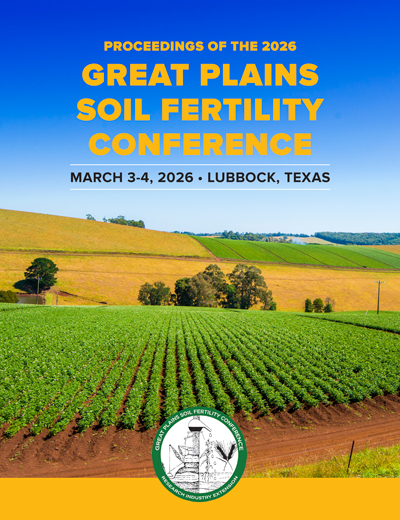
Conference Proceedings Available!
Proceedings
Authors
| Filter results11 paper(s) found. |
|---|
1. Soil Quality and Nitrogen Availability After Eight Years of a Mixed Cover Crop - Wheat RotationDespite a large interest in cover crops in the northern Great Plains, little is known about their effect on both the following wheat crop and soil quality. In 2012, a cover crop study was started in Montana to compare wheat production and soil quality after growing cover crop mixes containing 2-, 6-, or 8-species, with both summer fallow and a sole pea cover crop control, in a 2-yr rotation with wheat. The 2-species mixes represented functional groups (legumes, brassicas, tap rooted, or fibrous... C. Jones, P. Miller, C. Zabinski, K. D'agati |
2. Post-Wheat Summer Cover Crop Effects Crop Yields and Soil Properties in a No-till Dryland Cropping SystemTraditional dryland cropping systems in the semi-arid Great Plains include long fallow periods of up to 14 months to conserve soil moisture. However, such systems are inefficient even under continuous no-till (NT) management. As less water is necessary to produce forage compared to grain, cover crops (CCs) may be successfully integrated into dryland crop rotations for increased soil cover and potentially greater income when hayed or grazed as annual forages. One study was initiated in 2016 near... L.M. Simon, A.K. Obour, J.D. Holman, M.E. Schipanski, S.K. Johnson, K.L. Roozeboom |
3. Nitrogen Fertilizer Application and Depth of Moist Soil at Planting Affected Grain Sorghum YieldThe depth of moist soil before planting is critical for grain crop production in intensified dryland cropping systems. We investigated depth of moist soil at planting and nitrogen (N) fertilizer application rate effects on continuous grain sorghum yields on a Crete silt loam soil over 32-years in western Kansas. Treatments were four N rates (0, 20, 40 and 60 lb ac-1) in a randomized complete blocks design with four replication and depth of moist soil at planting determined with Paul... A.K. Obour, J.D. Holman, Y.M. Assefa, L.M. Simon, P. Mauler |
4. Lentil Nitrogen Fixation Response to Fertilizer and Inoculant in the Northern Great PlainsLentil production in the semi-arid northern Great Plains has increased dramatically over the past two decades, providing agroecosystem benefits of efficient water use, pest cycle disruption, and biological nitrogen (N) fixation. Through N fixation, lentil may help alleviate soil acidification and groundwater contamination by reducing N fertilizer needs. Despite widespread farmer adoption of lentil in the region, little is known about the benefits of fertilizer or inoculant type concerning N fixation.... K. Baber, C. Jones, P. Miller, S. Koeshall |
5. Soil Properties Affected by Grazing and Tillage of Annual ForagesNo-till (NT) management of annual crop production systems increases precipitation capture and storage. However, compaction with annual livestock grazing and the development of herbicide resistant weeds present challenges to long-term NT. An on-farm study was established in 2016 near Jetmore, KS to investigate the influence of annual tillage with a sweep plow compared to NT in a grazed continuous winter triticale production system. Forage productivity as well as weed density and soil properties... P. Mauler, J. Holman , A. Obour , L. Simon, K. Roozeboom |
6. Dramatic Soil Health Changes After 18 Years of Different Nitrogen Rates and Cropping Systems in the Northern Great PlainsRelatively few long-term cropping and nitrogen rates studies have been conducted in the semi-arid northern Great Plains that assess soil health changes. A cropping system study was initiated in 2002 in Bozeman, Montana (~400 mm annual precipitation) with wheat grown in even years, and either tilled fallow or one of the following no-till systems in odd years: fallow, wheat, pea grain, pea hay, pea green manure, and an alfalfa-grass (until 2012) followed by pea grain. N was applied at either 50%... C. Jones, P. Miller, C. Zabinski, W. Fouts |
7. Lentil Inoculant, Potassium, Sulfur, and Micronutrient Effects on Yield and Protein in the Northern Great PlainsLentil (Lens culinaris Medikus) is an important crop, averaging more than 600,000 ac in MT and ND from 2016-20. However, relatively little is known about inoculant and fertility response in lentil in the U.S. northern Great Plains. The objective of this experiment was to evaluate the effect of rhizobial inoculant formulations (granular and seed-coat) and nutrient additions (K, S, and micronutrients), on lentil growth, yield, and seed protein. This study was conducted at six or seven university... P. Miller, C. Jones, S. Atencio, C. Chen, E. Eriksmoen, S. Fordyce, P. Lamb, M. Ostlie, J. Rickertsen, M.A. Grusak, M. Bourgault, B. Franck, P. Carr, S. Koeshall, K. Baber |
8. Increasing Winter Wheat Grain Yield By Replicating the Management Adopted in High-Yielding Commercial FieldsLarge winter wheat (Triticum aestivum) yield gaps between farmer yields and yield potential in the southern Great Plains indicate the need to improve recommendations of best management strategies to profitably bridge this gap. Many studies have been completed on individual management factors pre-determined by the individual researcher, but we are not aware of studies comparing combination of practices that producers are currently using, which would be more relevant for real-world scenarios.... L.P. Ryan, R.P. Lollato, L. Haag, J. Holman |
9. Lime Management in the Semi-arid Regions of the USSoil acidity is increasing in the semi-arid regions of the US; however, questions exist about the efficacy of different liming products to raise soil pH and how long the lime benefits last. Therefore, we conducted two studies: 1) To monitor the efficacy of three liming products: sugarbeet lime (tilled and non-tilled), prilled lime (seed-placed), and aglime (tilled) to improve soil pH and crop yields at two sites in Montana and 2) To evaluate how different sugarbeet lime rates perform to mitigate... M. Rakkar, C. Jones, P. Miller, K. Mcvay, R. Engel |
10. Effect of Seeding Rate on Annual Warm Season Forage Yield and Plant StructureDue to the decline of the Ogallala Aquifer and reduced irrigation capacity, there is growing interest in more water-efficient cropping systems in the semi-arid central Great Plains. To support the region’s livestock industry, there is increased interest in forages because they use water more efficiently than grain crops. However, there is insufficient information on summer annual forage seeding rates in the range of environments encountered in the region. The objective of this study was... J. Holman, N. Detter, A. Obour, P. Tamea |
11. Summer Annual Legumes: Yield Potential and Water UseDue to the decline of the Ogalla Aquifer and reduced irrigation capacity, there is a growing interest in more water-efficient cropping systems in the semi-arid central Great Plains. One of the most water-intense crops grown on the semi-arid central Great Plains is alfalfa (Medicago sativa L.). Alfalfa is grown for its nutritive value and protein, which is highly desired by cow/calf, feed yards, and dairies of the central and southern Great Plains. The purpose of this study was to evaluate... J. Holman, N. Detter, A. Obour, L. Haag, K. Roozeboom |