Conference Proceedings Available!
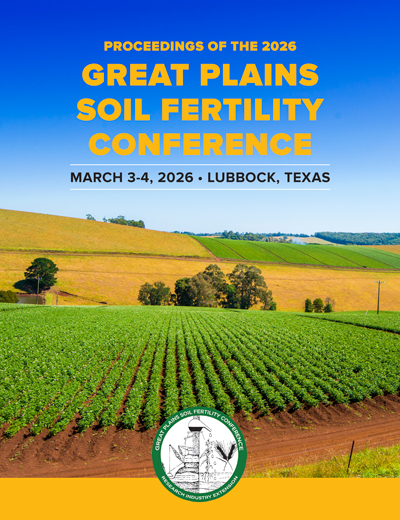
 
The 2026 Great Plains Soil Fertility Conference Proceedings Book is now available! Click the link below to view the full document!
 
2026_GPSFC_Proceedings.pdf

Proceedings

Find matching any: Reset
Tollefson, D
Ramos do Prado, M
Gao, X
Thorne, J
Biaou, A
Add filter to result:
Authors
Proulx, M
Gao, X
Matschek, R
Noland, R
Nielson, N
Thorne, J
McCulloch, M
Silva, J
Drescher, G
Roberts, T
KELLEY, J
Smartt, A
Sarfaraz, Q
RONGEY, W
Andrade Leite Mengez, G
Ramos do Prado, M
Silva, J
Drescher, G
Roberts, T
Slaton, N
Smartt, A
Sarfaraz, Q
Andrade Leite Mengez, G
Ramos do Prado, M
Drescher, G
Roberts, T
Popp, M
Slaton, N
Ramos do Prado, M
Smartt, A
Sarfaraz, Q
Andrade Leite Mengez, G
Foster, A
Hagele, J
Donoho, T
Tollefson, D
Topics
Student
General
Type
Oral
Poster
Year
2026
Home » Authors » Results

Authors

Filter results6 paper(s) found.

1. Wheat Zinc Nutrition: Agronomic Biofortification That Delivers Yield and Better Grain Nutrition

Low Zn availability in calcareous soils is a common issue in the Canadian prairies, where much of the wheat is exported, making Canada one of the world’s largest wheat exporters. Globally, 19% of the population, mostly pregnant women, infants, and children, suffers from Zn deficiency, highlighting the need to enhance Zn bioavailability in wheat grain. Agronomic biofortification offers a promising strategy to improve grain nutrient density while optimizing plant health and development. While... M. Proulx, X. Gao

2. Sheep Grazing Preference and Nutrient Cycling Implications Among Cover Crop Species

The vast and interspersed livestock and crop industries of Texas lend opportunity for livestock integration to benefit regional agricultural systems. Texas leads sheep production in the U.S. and small ruminant integration in crop systems has become an appealing opportunity in recent years due to strong meat markets and generally poor commodity crop markets. Many winter cover crops are likely suitable forages, and challenges of nutrient immobilization could be (at least partially) mitigated by... R. Matschek, R. Noland, N. Nielson, J. Thorne, M. Mcculloch

3. Defining Critical Tissue-Potassium Concentrations for Furrow Irrigated Corn Production

Potassium (K) is a critical nutrient for adequate corn (Zea mays L.) production, and tissue testing is an essential tool to ensure adequate K nutrition. Despite the important role of K in plant physiological functions, there are no calibrated critical tissue-K concentrations (TKc) for furrow-irrigated corn in Arkansas. This study aimed to define critical TKc values to maximize corn grain yield across different growth stages. From 2022 to 2024, twelve single-site-year and four long-term... J. Silva, G. Drescher, T. Roberts, J. Kelley, A. Smartt, Q. Sarfaraz, W. Rongey, G. Andrade leite mengez, M. Ramos do prado

4. Long-term Effects of Cover Cropping and Potassium and Phosphorus Fertilization on Soil Test Results in a Row Crop Production System

Potassium (K) and phosphorus (P) availability can be affected by fertilizer inputs and the use of cover crops (CC) through their effects on nutrient cycling. This study aims to evaluate the long-term effects of CC and fertilizer-P and -K applications on soil-test K (STK) and soil-test P (STP) in two long-term field-scale experiments. Field trials were established in 2017 on silt-loam soils at the Lon Mann Cotton Research Station (LMCRS) and at the Rohwer Research Station (RRS), Arkansas. Each... J. Silva, G. Drescher, T. Roberts, N. Slaton, A. Smartt, Q. Sarfaraz, G. Andrade leite mengez, M. Ramos do prado

5. Season-long Tools for Effective Potassium Management in Arkansas Cotton Production

Knowledge of how accurately soil testing and plant analysis identify nutrient-deficient soils and recommend the proper fertilizer rate is important to ensure farmers are profitable. However, critical tissue-potassium (K) concentrations have not been established for modern high-yielding cotton (Gossypium hirsutum L.) cultivars currently grown across the U.S. cotton belt. Likewise, limited research has investigated the window of opportunity to correct K-deficient cotton with in-season fertilization... G. Drescher, T. Roberts, M. Popp, N. Slaton, M. Ramos do prado, A. Smartt, Q. Sarfaraz, G. Andrade leite mengez

6. Managing High-pH Soils: Restoring Nutrient Function with Polysulphate and Acidic Phosphate Fertilizers

High soil pH often reflects the active consumption of hydrogen ions (H⁺) by carbonates and bicarbonates, which suppresses calcium solubility and reduces the availability of phosphorus, potassium, and key micronutrients. These limitations are driven by soil chemistry rather than true nutrient deficiency, restricting nutrient mobility and root access. This presentation will examine Polysulphate® as a functional calcium and sulfate source that improves system efficiency. In addition, ICL... A. Foster, J. Hagele, T. Donoho, D. Tollefson