Conference Proceedings Available!

 
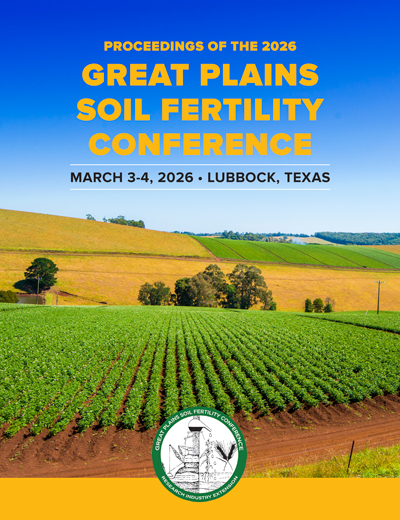
The 2026 Great Plains Soil Fertility Conference Proceedings Book is now available! Click the link below to view the full document!
 
2026_GPSFC_Proceedings.pdf

Proceedings

Find matching any: Reset
Smith, N
Foster, A
Slaton, N
Mathey, N
Baker, M
Carson, Z
Pokharel, D
DeLaune,
Mbuya, O
Roth , R
Silva, J
Laza, H
Ward, R
Polkinghorne, A
Donoho, T
Schwartze, J
Add filter to result:
Authors
Carson, Z
Obour, A
Holman, J
Roozeboom, K
Schwartze, J
Ruiz Diaz, D
Obour, A
Holman, J
Brian, O
Reiman, M
Rosa, A
Baker, M
Yost, M.A
Hussain, T
Noland, R
Matschek, R
DeLaune,
Kimura , E
Muir, J
Drescher, G
Roberts, T
Popp, M
Slaton, N
Ramos do Prado, M
Smartt, A
Sarfaraz, Q
Andrade Leite Mengez, G
Derrick, J
Arnall, B
Mathey, N
Oliveira Liberato, B
Camacho, C
Arnall, B
Reed, V
Roberts, T
Roth , R
Steinke, K
Jones, J
Quinn, D
Pokharel, D
Foster, A
Hagele, J
Donoho, T
Tollefson, D
Ward, R
Topics
Student
General
Type
Oral
Poster
Year
2026
Home » Authors » Results

Authors

Filter results10 paper(s) found.

1. Forages and Livestock to Diversify Wheat-based Cropping System

Integrating annual forages and ruminant livestock to intensify dryland cropping systems have the potential to increase profitability, increase water use efficiency, and improve soil health. The objective of this study was to determine the crop yield and soil property impacts of intensifying traditional no-till winter wheat (Triticum aestivum L.)-grain sorghum (Sorghum bicolor Moench)-fallow (W-GS-F) with annual forages as well as integrating livestock. This study was initiated... Z. Carson, A. Obour, J. Holman, K. Roozeboom

2. Impacts of Crop Management on Grain Yield, Grain Quality, Cover Crop Biomass, Residue Cover, and Residual Nitrogen in Dryland Systems

Crop production depends on interactions among management practices, yet most studies evaluate the effect of individual practices rather than their interaction. This field experiment was established in 2024 at the Kansas State University Harold and Olympia Lonsinger Sustainability Farm (Osborne County, Kansas) to assess how combinations of common practices affect crop productivity and soil properties in a dryland system Treatments were a factorial combination of crop rotations (continuous... J. Schwartze, D. Ruiz diaz, A. Obour, J. Holman, O. Brian, M. Reiman, A. Rosa

3. Phosphorus and Potassium Impacts on Field Crop Production in the Intermountain West

Macronutrients such as phosphorus (P), potassium (K), and sulfur (S) are essential nutrients often required in large quantities for optimal plant growth, with fertilizers typically supplementing soil nutrients. Fertilizer recommendations can vary significantly depending on the source and greatly affect crop profitability. Guidelines in Utah and many other states in the region were developed decades ago and need to be reassessed. Current Utah State University (USU) Guidelines identify 15 mg kg-1,... M. Baker, M.A. Yost

4. Cover Crop Function and Management Optimization for Semiarid West Texas Cropping Systems

Water-use is a primary concern preventing integration of cover crops in dry climates. Recent research has demonstrated that  adequate cover crop residue (with optimal termination timing) is more likely to improve soil water dynamics for the subsequent crop. Regarding cover crop function in West Texas, wheat stubbles as a fallow may offer a cheap and effective solution to prevent wind erosion and facilitate water storage in soil profile. Optimum management practices are likely different though... T. Hussain, R. Noland, R. Matschek, . Delaune, E. Kimura , J. Muir

5. Season-long Tools for Effective Potassium Management in Arkansas Cotton Production

Knowledge of how accurately soil testing and plant analysis identify nutrient-deficient soils and recommend the proper fertilizer rate is important to ensure farmers are profitable. However, critical tissue-potassium (K) concentrations have not been established for modern high-yielding cotton (Gossypium hirsutum L.) cultivars currently grown across the U.S. cotton belt. Likewise, limited research has investigated the window of opportunity to correct K-deficient cotton with in-season fertilization... G. Drescher, T. Roberts, M. Popp, N. Slaton, M. Ramos do prado, A. Smartt, Q. Sarfaraz, G. Andrade leite mengez

6. Monitoring Nitrogen Transformations and Their Interaction with Potassium Uptake in Cotton Production Systems

Understanding the temporal dynamics of soil nitrogen (N) is critical for optimizing nutrient management in cotton production. This research monitored soil N transformations, specifically ammonium (NH₄⁺) and nitrate (NO₃⁻), throughout the cotton growing season. An additional focus was also placed on interactions between soil N forms and the uptake of essential plant nutrients, particularly potassium (K). Soil samples were collected at multiple depths and time points across different management... J. Derrick, B. Arnall, N. Mathey, B. oliveira liberato, C. Camacho

7. Nitrogen and Sulfur Interaction in Corn Production- Multi-state Study

Multi-state effort to better understand the impact of sulfure fertilization on nitrogen response curve in corn production. Over 30 site years harvested in 2025. ... B. Arnall, V. Reed, T. Roberts, R. Roth , K. Steinke, J. Jones, D. Quinn

8. Evaluating the Existing Calibration Curve for Sensor-Based N Management in Grain Sorghum

Nitrogen (N) response in grain sorghum is spatially and temporally variable, complicating estimation of optimum N rates and limiting the effectiveness of uniform fertilizer recommendations. This study evaluated within-field and year-to-year variability in N response using block-level response modeling and soil variability analysis. Field experiments were conducted in Stillwater, Oklahoma, during the 2024 and 2025 growing seasons using six N fertilizer rates (0,39, 79, 118, 157, and 196 kg N ha⁻¹).... D. Pokharel

9. Managing High-pH Soils: Restoring Nutrient Function with Polysulphate and Acidic Phosphate Fertilizers

High soil pH often reflects the active consumption of hydrogen ions (H⁺) by carbonates and bicarbonates, which suppresses calcium solubility and reduces the availability of phosphorus, potassium, and key micronutrients. These limitations are driven by soil chemistry rather than true nutrient deficiency, restricting nutrient mobility and root access. This presentation will examine Polysulphate® as a functional calcium and sulfate source that improves system efficiency. In addition, ICL... A. Foster, J. Hagele, T. Donoho, D. Tollefson

10. The Past, Present, and Future of Soil Testing

A keynote adress from Dr. Ray Ward, Founder of Ward Laboratories, Inc. ... R. Ward